 |
pulsatrix 1.1.0
|
|
pulsatrix 1.1.0
|
Anchors (Ribeiro, Singh and Guestrin, "Anchors: High-Precision Model-Agnostic Explanations", AAAI 2018): an if-then rule around one input that keeps the model's prediction with high probability, whatever the other features do (XAI-4). More...
#include <cstdint>#include <functional>#include <limits>#include <string>#include <vector>#include "pulsatrix/json.hpp"#include "pulsatrix/tensor.hpp"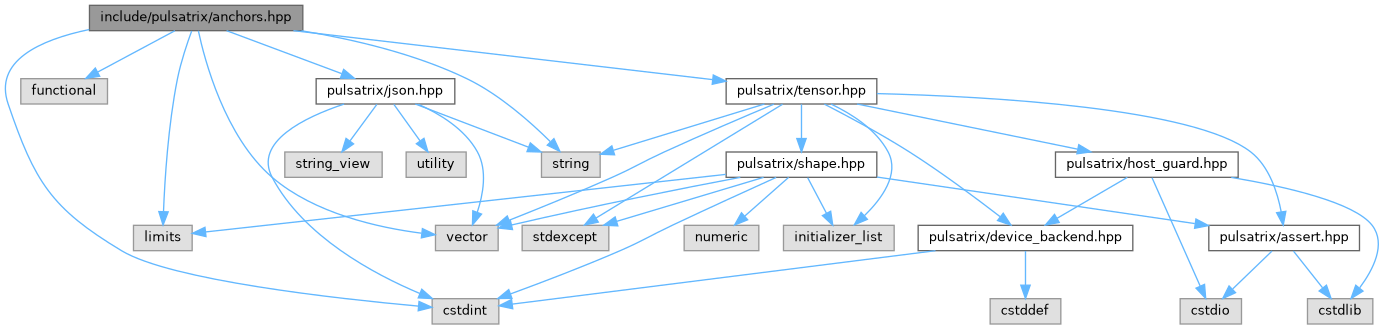
Go to the source code of this file.
Classes | |
| struct | pulsatrix::AnchorOptions |
| FindAnchor's settings. The defaults are the reference implementation's, except a beam of 2 and epsilon_stop. More... | |
| struct | pulsatrix::AnchorPredicate |
lower < x[feature] <= upper; a missing side is infinite. More... | |
| struct | pulsatrix::Anchor |
| FindAnchor()'s result. More... | |
Namespaces | |
| namespace | pulsatrix |
Functions | |
| Anchor | pulsatrix::FindAnchor (const std::function< Tensor(const Tensor &)> &predict, const Tensor &input, const std::vector< Tensor > &background, const AnchorOptions &options={}) |
Finds an anchor for the model's prediction on input. | |
| std::string | pulsatrix::DescribeAnchor (const Anchor &anchor, const std::vector< std::string > &feature_names={}) |
IF income > 0.71 AND debt <= -0.12 THEN class 1 (precision 0.97, coverage 0.21). | |
| JsonValue | pulsatrix::ToJson (const Anchor &anchor, const std::vector< std::string > &feature_names={}) |
The anchor as a pulsatrix.anchor.v1 document; an infinite bound is null. | |
The KL bounds KL-LUCB uses (Kaufmann and Kalyanakrishnan 2013), as in the reference code. | |
| double | pulsatrix::BernoulliKl (double p, double q) |
| KL divergence between Bernoulli(p) and Bernoulli(q), with p and q clipped to (0, 1). | |
| double | pulsatrix::KlUpperBound (double p, double level) |
| The largest q >= p with BernoulliKl(p, q) <= level. | |
| double | pulsatrix::KlLowerBound (double p, double level) |
| The smallest q <= p with BernoulliKl(p, q) <= level. | |
Anchors (Ribeiro, Singh and Guestrin, "Anchors: High-Precision Model-Agnostic Explanations", AAAI 2018): an if-then rule around one input that keeps the model's prediction with high probability, whatever the other features do (XAI-4).
An anchor answers "how to still be this": which conditions, if they hold, keep the prediction. IF income > 0.71 AND debt <= -0.12 THEN class 1, with
The predicates are the reference implementation's for ordinal features: each feature is cut at the background's percentiles (quartiles by default), and every half-line at a cut that contains the input is a predicate, x > e for cuts below the input and x <= e for cuts above it. An anchor may hold two on one feature, which make an interval. An input satisfying the anchor is drawn by taking a random background row and, for each anchored feature, a background value inside its interval; features are drawn independently of one another, as the reference implementation does when too few rows satisfy every predicate at once.
The search is the paper's: a beam search that adds one predicate at a time, using KL-LUCB to find the most precise candidates with few model calls, and keeps, among the anchors whose precision clears the threshold, the one with the highest coverage.
 1.9.8