 |
pulsatrix
|
|
pulsatrix
|
ASHA (Asynchronous Successive Halving Algorithm; Li, Jamieson, Rostamizadeh, Gonina, Hardt, Recht, Talwalkar, "A System for Massively Parallel Hyperparameter Tuning," MLSys 2020): unlike synchronous Successive Halving/Hyperband (which process one full rung across every candidate before any candidate advances to the next), ASHA promotes a candidate to the next rung as soon as it qualifies (its metric is in the top 1/eta fraction of every candidate that has ever completed that rung so far), never waiting on the rest of the current rung's population. More...
#include <algorithm>#include <functional>#include <limits>#include <memory>#include <stdexcept>#include <vector>#include "pulsatrix/successive_halving.hpp"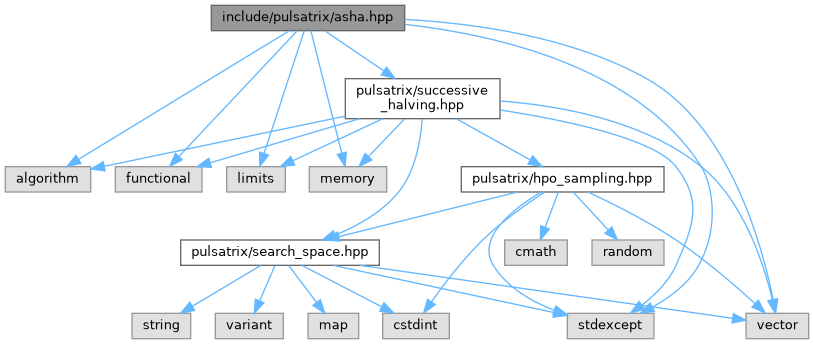
Go to the source code of this file.
Classes | |
| struct | pulsatrix::ASHAResult |
| The best configuration/metric found, the total epoch budget spent, and how many distinct configurations were ever started (as opposed to promoted). More... | |
| struct | pulsatrix::detail::ASHACandidate |
Namespaces | |
| namespace | pulsatrix |
| namespace | pulsatrix::detail |
Functions | |
| ASHAResult | pulsatrix::RunASHAOnConfigQueue (std::vector< Configuration > config_queue, const TrialFactory &make_trial, int initial_epoch_budget, double eta, int num_rungs) |
| Runs ASHA, drawing new configurations from an explicit, ordered queue (rather than sampling indefinitely) – the pure, deterministic core; RunASHA (below) is the thin SearchSpace/RNG-sampling wrapper around it. | |
| template<typename RNG > | |
| ASHAResult | pulsatrix::RunASHA (const SearchSpace &space, const TrialFactory &make_trial, size_t max_configs_started, int initial_epoch_budget, double eta, int num_rungs, RNG &rng) |
| RNG-driven wrapper: draws max_configs_started configurations from space via RandomSample to serve as the queue, then runs RunASHAOnConfigQueue. | |
ASHA (Asynchronous Successive Halving Algorithm; Li, Jamieson, Rostamizadeh, Gonina, Hardt, Recht, Talwalkar, "A System for Massively Parallel Hyperparameter Tuning," MLSys 2020): unlike synchronous Successive Halving/Hyperband (which process one full rung across every candidate before any candidate advances to the next), ASHA promotes a candidate to the next rung as soon as it qualifies (its metric is in the top 1/eta fraction of every candidate that has ever completed that rung so far), never waiting on the rest of the current rung's population.
 1.9.8
1.9.8