 |
pulsatrix 1.1.0
|
|
pulsatrix 1.1.0
|
AttnLRP parity with LXT on a real language model (LLM-7): pulsatrix's relevance against LXT's own AttnLRP on the same Hugging Face model and tokens. More...
#include <cstdint>#include <map>#include <string>#include <vector>#include "pulsatrix/causal_lm.hpp"#include "pulsatrix/lrp_rule_config.hpp"#include "pulsatrix/safetensors.hpp"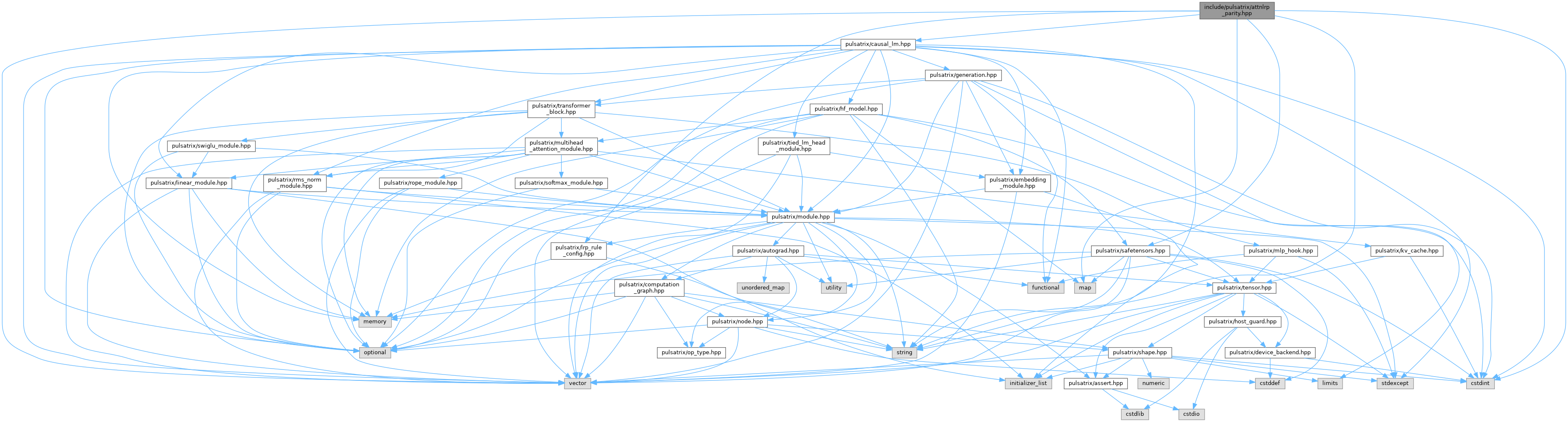
Go to the source code of this file.
Classes | |
| struct | pulsatrix::AttnLrpSequenceResult |
| One reference sequence's comparison. More... | |
| struct | pulsatrix::AttnLrpReport |
| A model's comparison against an AttnLRP reference file. More... | |
Namespaces | |
| namespace | pulsatrix |
Functions | |
| double | pulsatrix::PearsonCorrelation (const std::vector< float > &x, const std::vector< float > &y) |
| Pearson correlation of two equal-length vectors; 0 if either is constant. | |
| LRPRuleConfig | pulsatrix::LxtAttnLrpConfig () |
| The rule configuration that matches LXT's AttnLRP on a Hugging Face model: the epsilon rule with a tiny epsilon, biases kept in the denominator as LXT's gradient * input keeps them in z (Qwen2's QKV biases), and LayerNorm with only its standard deviation held constant (LRPRuleConfig::layer_norm_detach_std; ESM-2, PLM-6). | |
| AttnLrpReport | pulsatrix::CompareToAttnLrp (CausalLM &model, const SafetensorsFile &reference, const LRPRuleConfig &config=LxtAttnLrpConfig(), float threshold=0.99f) |
Explains each ids.<k> sequence of an AttnLRP reference file (as written by tools/golden/make_attnlrp_reference.py) from the logit of target.<k> at the last position, seeded with that logit as LXT's examples do, and compares the input relevance and every layer's K/V-head relevance with the reference's. | |
AttnLRP parity with LXT on a real language model (LLM-7): pulsatrix's relevance against LXT's own AttnLRP on the same Hugging Face model and tokens.
 1.9.8