 |
pulsatrix
|
|
pulsatrix
|
A CMA-ES-*style* ask-tell evolutionary strategy (Hansen & Ostermeier's Covariance Matrix Adaptation Evolution Strategy) for continuous hyperparameter search: an adaptive mean, a per-dimension adaptive scale (separable/diagonal covariance, Ros & Hansen, "A Simple Modification in CMA-ES Achieving Linear Time and Space Complexity," PPSN 2008), and an adaptive global step size. More...
#include <algorithm>#include <cmath>#include <numeric>#include <random>#include <stdexcept>#include <vector>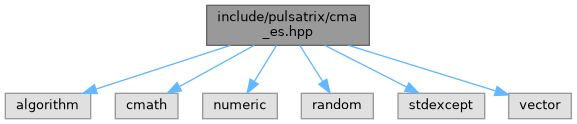
Go to the source code of this file.
Classes | |
| struct | pulsatrix::CMAESState |
| This algorithm's full adaptive state: the search mean, the global step size, and each dimension's own variance (the diagonal of the covariance matrix). More... | |
| class | pulsatrix::CMAES |
| RNG-driven ask-tell wrapper: caches the z-samples an Ask() call draws so a matching Tell() call can reuse them without the caller needing to track them. More... | |
Namespaces | |
| namespace | pulsatrix |
Functions | |
| std::vector< std::vector< double > > | pulsatrix::AskGivenSamples (const CMAESState &state, const std::vector< std::vector< double > > &z_samples) |
| Pure core: decodes an explicit set of standard-normal sample vectors into offspring points, x_i = mean + sigma * sqrt(variances) (elementwise) * z_i. | |
| CMAESState | pulsatrix::TellGivenSamples (const CMAESState &state, const std::vector< std::vector< double > > &z_samples, const std::vector< std::vector< double > > &offspring, const std::vector< double > &fitness, double step_size_learning_rate, double scale_learning_rate) |
| Pure core: given the offspring AskGivenSamples produced (same order), their maximization-convention fitness values, and the z_samples that produced them, returns the next generation's state. | |
A CMA-ES-*style* ask-tell evolutionary strategy (Hansen & Ostermeier's Covariance Matrix Adaptation Evolution Strategy) for continuous hyperparameter search: an adaptive mean, a per-dimension adaptive scale (separable/diagonal covariance, Ros & Hansen, "A Simple Modification in CMA-ES Achieving Linear Time and Space Complexity," PPSN 2008), and an adaptive global step size.
 1.9.8
1.9.8