 |
pulsatrix 1.1.0
|
|
pulsatrix 1.1.0
|
Distances between persistence diagrams, bottleneck and Wasserstein, and Certified<T>, a value with the error bounds behind it. More...
#include <numeric>#include <string>#include <vector>#include "pulsatrix/tda/persistence_diagram.hpp"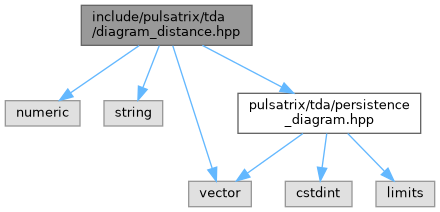
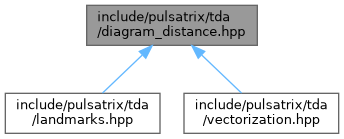
Go to the source code of this file.
Classes | |
| struct | pulsatrix::ErrorTerm |
| One source of error in a Certified value. More... | |
| struct | pulsatrix::Certified< T > |
| A computed value and a certified bound on its error, itemized by source: the exact value is within bound() of value. More... | |
Namespaces | |
| namespace | pulsatrix |
Functions | |
| Certified< double > | pulsatrix::BottleneckDistance (const PersistenceDiagram &a, const PersistenceDiagram &b) |
| The bottleneck distance between two diagrams of the same dimension. | |
| double | pulsatrix::WassersteinDistance (const PersistenceDiagram &a, const PersistenceDiagram &b, double order=2) |
| The q-Wasserstein distance between two diagrams of the same dimension, with the L-infinity norm between points. | |
Distances between persistence diagrams, bottleneck and Wasserstein, and Certified<T>, a value with the error bounds behind it.
Two diagrams are compared by matching their points: each point either to a point of the other diagram or to the diagonal (where a feature of zero persistence would sit). The bottleneck distance is the smallest possible largest move; the q-Wasserstein distance the smallest q-th root of the sum of q-th powers of the moves. Moves are measured in the L-infinity norm, as in the stability theorem, so a point (b, d) is (d - b) / 2 from the diagonal.
The bottleneck distance is the one stability is stated in: two point clouds whose distance matrices differ by at most e have diagrams within e (Chazal, de Silva and Oudot 2014). It lets layers, models and seeds be compared with an error bar, which is why it returns a Certified value.
 1.9.8