 |
pulsatrix 1.1.0
|
|
pulsatrix 1.1.0
|
Whether two models explain the same inputs with the same evidence (roadmap KD-2): a distilled student against its teacher, a fine-tuned model against its base, or any two models that take the same input. More...
#include <cstdint>#include <vector>#include "pulsatrix/attribution.hpp"#include "pulsatrix/explanation_metrics.hpp"#include "pulsatrix/json.hpp"#include "pulsatrix/representation_similarity.hpp"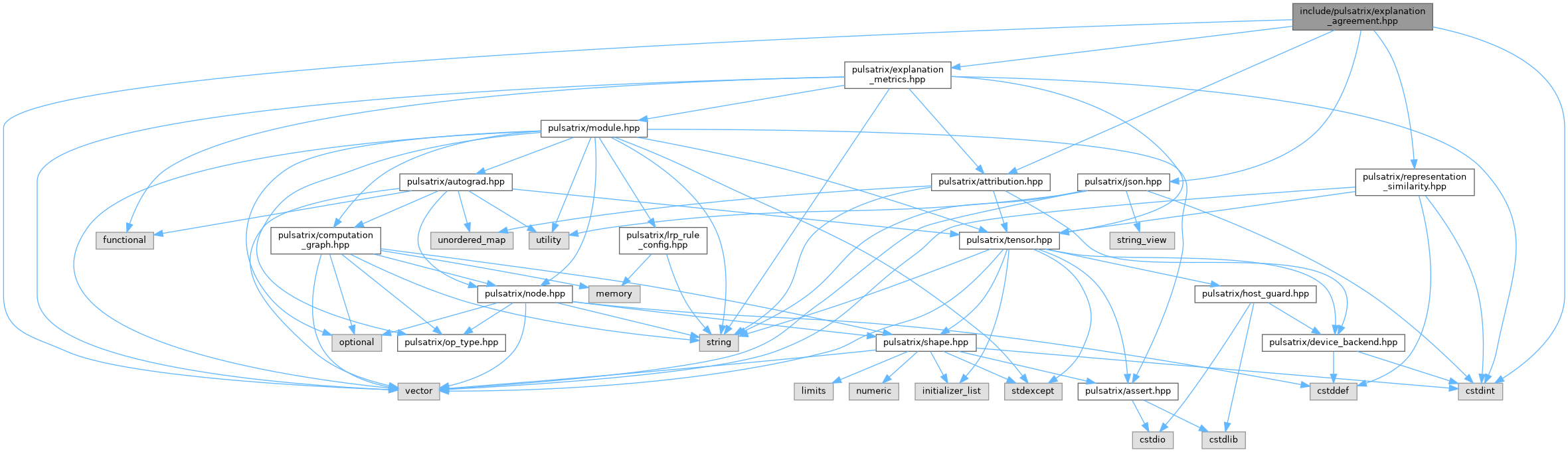
Go to the source code of this file.
Classes | |
| struct | pulsatrix::AgreementOptions |
| CompareExplanations()'s settings. More... | |
| struct | pulsatrix::InputAgreement |
| How one input's two attributions compare. More... | |
| struct | pulsatrix::AgreementReport |
| CompareExplanations()'s result. More... | |
Namespaces | |
| namespace | pulsatrix |
Functions | |
| AgreementReport | pulsatrix::CompareExplanations (const std::vector< Attribution > &teacher, const std::vector< Attribution > &student, const AgreementOptions &options={}) |
| Compares two models' attributions of the same inputs, in the same order. | |
| AgreementReport | pulsatrix::ExplanationAgreement (const std::vector< Tensor > &inputs, const ExplainFn &teacher, const ExplainFn &student, const AgreementOptions &options={}) |
| Explains every input with both explainers, then CompareExplanations(). | |
| JsonValue | pulsatrix::ToJson (const AgreementReport &report) |
The report as a pulsatrix.explanation_agreement.v1 document. NaNs are written as null. | |
Whether two models explain the same inputs with the same evidence (roadmap KD-2): a distilled student against its teacher, a fine-tuned model against its base, or any two models that take the same input.
A student can match its teacher's outputs while relying on different features. The two models' attributions of the same inputs are compared input by input:
and across inputs by the linear CKA of the two (inputs × features) attribution matrices (INT-2), which asks whether the maps vary from input to input in the same way.
Two maps can agree only because every map looks alike: an image model's relevance gathers in the middle of every image, a language model's on the last token. So the student's maps are also compared with the teacher's maps of other inputs, and a permutation test asks whether the matched pairs agree more than mismatched ones do. Only that excess is evidence of the same reasoning about each input.
tests/explanation_agreement_test.cpp checks every number against tools/generate_explanation_agreement_reference_values.py (scipy and numpy, the same shuffles).
 1.9.8