 |
pulsatrix 1.1.0
|
|
pulsatrix 1.1.0
|
What did a fine-tune change? The fine-tuned model's relevance minus the base model's for the same prediction, input by input and token by token across a dataset, and intruder dimensions: new top singular directions in the fine-tuned weights (TRN-11). More...
#include <cstdint>#include <map>#include <string>#include <vector>#include "pulsatrix/lrp_rule_config.hpp"#include "pulsatrix/module.hpp"#include "pulsatrix/tensor.hpp"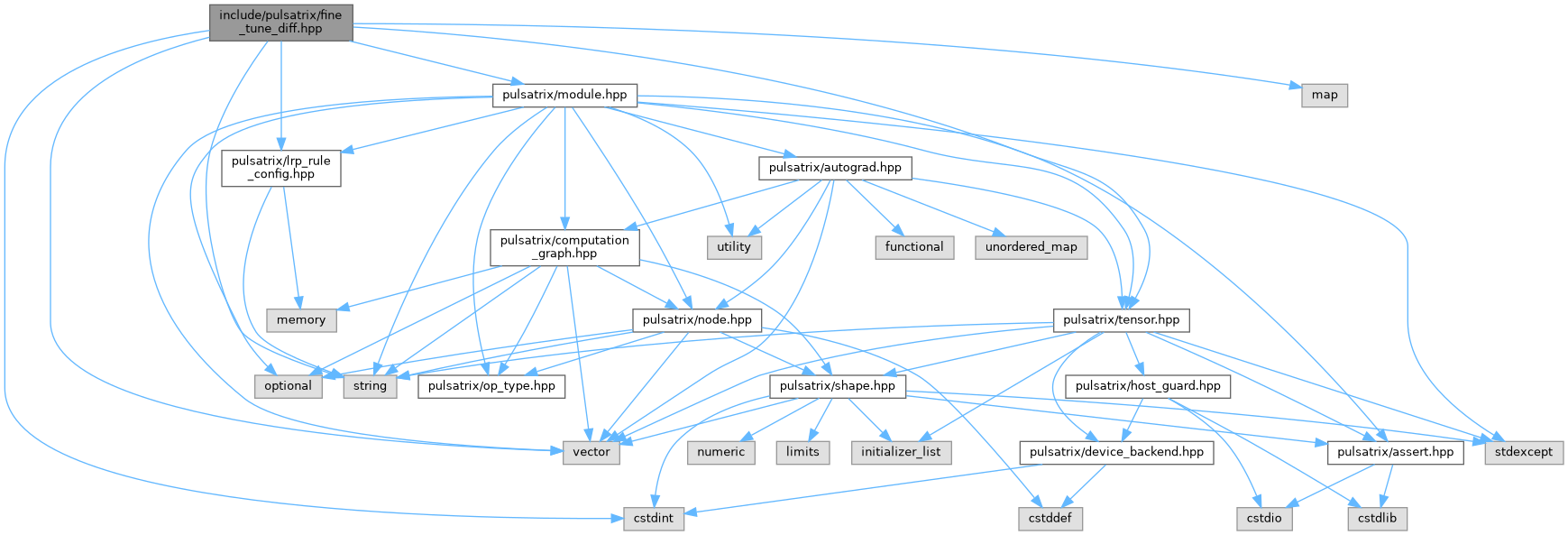
Go to the source code of this file.
Classes | |
| struct | pulsatrix::DiffTarget |
| Which output both models are asked to explain. More... | |
| struct | pulsatrix::RelevanceDiff |
| The two explanations of the same prediction, and their difference. More... | |
| struct | pulsatrix::TokenShift |
| One token's relevance shift, averaged over every occurrence seen. More... | |
| class | pulsatrix::TokenRelevanceShift |
| Collects RelevanceDiff results over a dataset by input token: which tokens a fine-tune made the model rely on more, and which less. More... | |
| struct | pulsatrix::IntruderResult |
| Intruder dimensions of one weight matrix (Shuttleworth et al., 2024, Definition 3.1). More... | |
| struct | pulsatrix::LayerIntruders |
| IntruderDimensions() for one named layer. More... | |
Namespaces | |
| namespace | pulsatrix |
Functions | |
| RelevanceDiff | pulsatrix::DiffRelevance (Module &base, Module &tuned, const Tensor &input, const DiffTarget &target={}, const LRPRuleConfig &config={}) |
Explains the same prediction in both models: forward() on input, then relevance seeded with each model's own score for the class, at the class only. | |
| RelevanceDiff | pulsatrix::DiffAdapterRelevance (Module &model, const Tensor &input, const DiffTarget &target={}, const LRPRuleConfig &config={}) |
DiffRelevance() for a fine-tune held as adapters on model: the tuned run with its LoRA adapters, IA³ vectors and (for a CausalLM) interventions on, the base run with them off. They are back on afterwards, even if a call throws. | |
| IntruderResult | pulsatrix::IntruderDimensions (const Tensor &base, const Tensor &tuned, int64_t k=10, double epsilon=0.6) |
Counts the top-k singular vectors of tuned that no singular vector of base resembles: |cos| < epsilon against every one of them. | |
| std::vector< LayerIntruders > | pulsatrix::LoraIntruderDimensions (Module &model, int64_t k=10, double epsilon=0.6) |
| Intruder dimensions of every LoRA layer: its base weight W against W + (alpha / r) A B. | |
| std::vector< LayerIntruders > | pulsatrix::IntruderDimensions (Module &base, Module &tuned, int64_t k=10, double epsilon=0.6) |
| Intruder dimensions of every LinearModule the two models share by name and shape: a full fine-tune against its base. | |
What did a fine-tune change? The fine-tuned model's relevance minus the base model's for the same prediction, input by input and token by token across a dataset, and intruder dimensions: new top singular directions in the fine-tuned weights (TRN-11).
Works for a fine-tune held as adapters on the base model (LoRA, IA³, LoReFT), which DiffAdapterRelevance() switches off and on, and for two separate models of the same architecture, such as a full fine-tune and its base, with DiffRelevance().
 1.9.8