 |
pulsatrix 1.1.0
|
|
pulsatrix 1.1.0
|
ProteinGym's metrics for how well predicted variant scores track measured fitness (PLM-3), computed exactly as ProteinGym's performance_DMS_benchmarks.py does.
More...
#include <vector>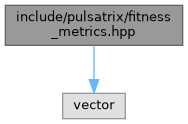
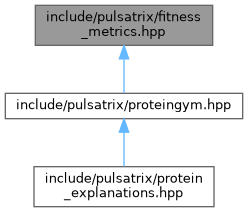
Go to the source code of this file.
Classes | |
| struct | pulsatrix::FitnessMetrics |
| All five, as ProteinGym reports them. More... | |
Namespaces | |
| namespace | pulsatrix |
Functions | |
| double | pulsatrix::SpearmanCorrelation (const std::vector< double > &x, const std::vector< double > &y) |
Spearman's rank correlation, ties given their average rank (scipy's spearmanr). NaN if either input is constant. | |
| double | pulsatrix::RocAuc (const std::vector< int > &labels, const std::vector< double > &scores) |
Area under the ROC curve of scores for labels (0 or 1), ties counted half (sklearn's roc_auc_score). NaN if only one class is present. | |
| double | pulsatrix::MatthewsCorrelation (const std::vector< int > &labels, const std::vector< int > &predicted) |
Matthews correlation of binary labels and predicted (sklearn's matthews_corrcoef); 0 when a row or column of the confusion matrix is empty. | |
| double | pulsatrix::MedianSplitMcc (const std::vector< int > &labels, const std::vector< double > &scores) |
ProteinGym's MCC: scores at or above their median predict 1. | |
| double | pulsatrix::Ndcg (const std::vector< double > &true_scores, const std::vector< double > &predicted, double top_percent=10.0) |
ProteinGym's NDCG: gains are the true scores min-max scaled to [0, 1]; the variants the model ranks in the top top_percent (floor of the count) contribute gain / log2(rank + 1), normalized by the same sum for the truly best ones. Zero gains are dropped. | |
| double | pulsatrix::TopRecall (const std::vector< double > &true_scores, const std::vector< double > &predicted, double top_true=10.0, double top_model=10.0) |
| ProteinGym's top recall: of the variants at or above the true scores' (100 - top) percentile, the fraction also at or above the predicted scores' percentile. Percentiles interpolate linearly, as numpy's do. | |
| double | pulsatrix::Percentile (std::vector< double > values, double q) |
| The q-th percentile (0 to 100) with linear interpolation (numpy's default). | |
| FitnessMetrics | pulsatrix::EvaluateFitness (const std::vector< double > &dms_scores, const std::vector< int > &dms_bins, const std::vector< double > &predicted) |
| FitnessMetrics for one assay: measured scores and their binarized labels, and predictions. | |
ProteinGym's metrics for how well predicted variant scores track measured fitness (PLM-3), computed exactly as ProteinGym's performance_DMS_benchmarks.py does.
 1.9.8