 |
pulsatrix 1.1.0
|
|
pulsatrix 1.1.0
|
Global sensitivity analysis: Morris elementary effects and Sobol indices (CFS-4). More...
#include <cstdint>#include <functional>#include <string>#include <vector>#include "pulsatrix/tensor.hpp"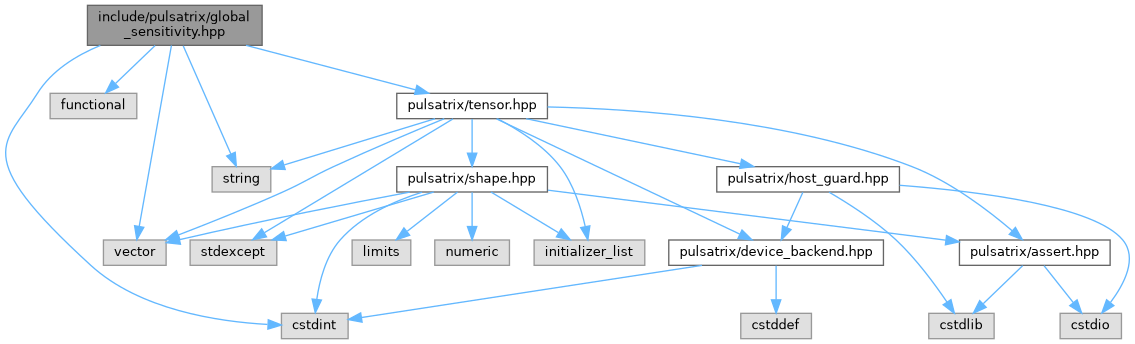
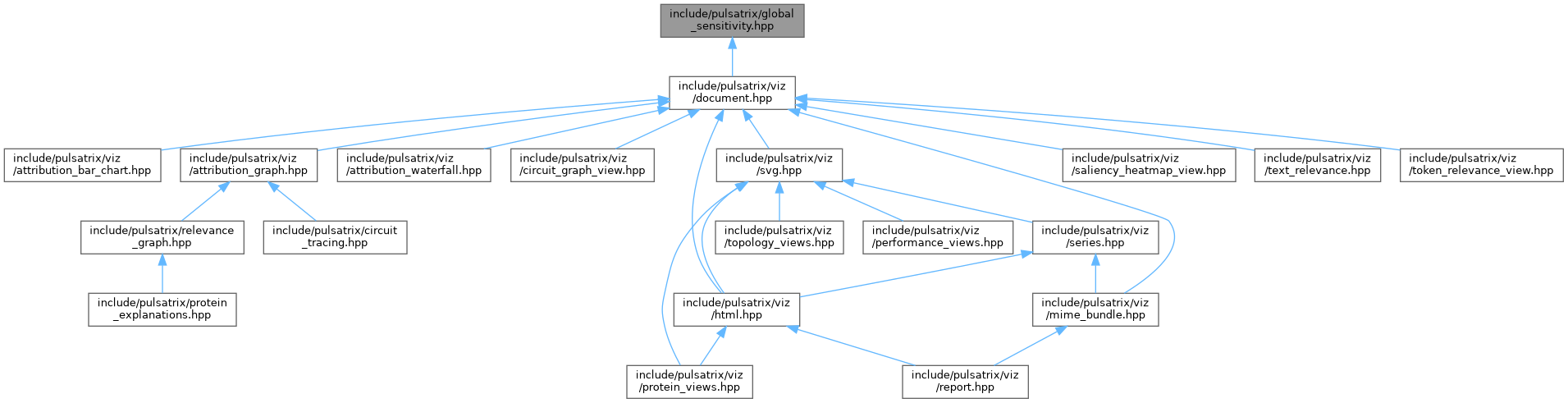
Go to the source code of this file.
Classes | |
| struct | pulsatrix::GlobalSensitivityProblem |
The input space to explore: which features vary, over which ranges. Every other feature keeps its value from base. More... | |
| struct | pulsatrix::MorrisResult |
Morris screening results, one entry per varied feature (SALib's morris.analyze). More... | |
| struct | pulsatrix::MorrisOptions |
| Morris settings. More... | |
| struct | pulsatrix::SobolResult |
Sobol indices, one entry per varied feature (SALib's sobol.analyze, first and total order). More... | |
| struct | pulsatrix::SobolOptions |
| Sobol settings. More... | |
Namespaces | |
| namespace | pulsatrix |
Functions | |
| std::vector< std::vector< float > > | pulsatrix::MorrisSample (const GlobalSensitivityProblem &problem, const MorrisOptions &options={}) |
| Morris trajectories (Morris 1991): each starts at a random grid point and moves one feature at a time, in a random order, by the Morris step. Rows are feature values in the problem's ranges, (num_features + 1) per trajectory. | |
| MorrisResult | pulsatrix::AnalyzeMorris (const std::vector< std::vector< float > > &samples, const std::vector< float > &outputs, const MorrisOptions &options={}) |
Morris statistics from samples laid out as MorrisSample's (or SALib's) trajectories and one output per row: the same elementary effects and mu, mu*, sigma as SALib 1.6 morris.analyze (unscaled). The confidence interval is a bootstrap with this library's own generator, so it agrees with SALib's in distribution, not digit for digit. | |
| MorrisResult | pulsatrix::ComputeMorris (const std::function< Tensor(const Tensor &)> &predict, const GlobalSensitivityProblem &problem, int64_t target_index, const MorrisOptions &options={}) |
| Samples, runs the model and analyzes: MorrisSample, then AnalyzeMorris. | |
| SobolResult | pulsatrix::AnalyzeSobol (const std::vector< float > &outputs, int64_t num_features, const SobolOptions &options={}) |
| Sobol indices from outputs in SALib's layout without second order: N blocks of (num_features + 2) outputs, f(A), f(AB_1) ... f(AB_D), f(B). Outputs are standardized first, then the first order uses Saltelli et al. (2010)'s estimator and the total order Jansen's, exactly as SALib 1.6 does. The bootstrap uses this library's generator. | |
| SobolResult | pulsatrix::ComputeSobol (const std::function< Tensor(const Tensor &)> &predict, const GlobalSensitivityProblem &problem, int64_t target_index, const SobolOptions &options={}) |
| Samples two independent uniform matrices A and B over the problem's ranges, builds the Saltelli design (AB_j is A with column j from B), runs the model on every row and calls AnalyzeSobol. | |
Global sensitivity analysis: Morris elementary effects and Sobol indices (CFS-4).
 1.9.8