 |
pulsatrix 1.1.0
|
|
pulsatrix 1.1.0
|
H0 persistence, the clusters of a point cloud across scales, from its minimum spanning tree. More...
#include <cstdint>#include <vector>#include "pulsatrix/tda/distance_matrix.hpp"#include "pulsatrix/tda/persistence_diagram.hpp"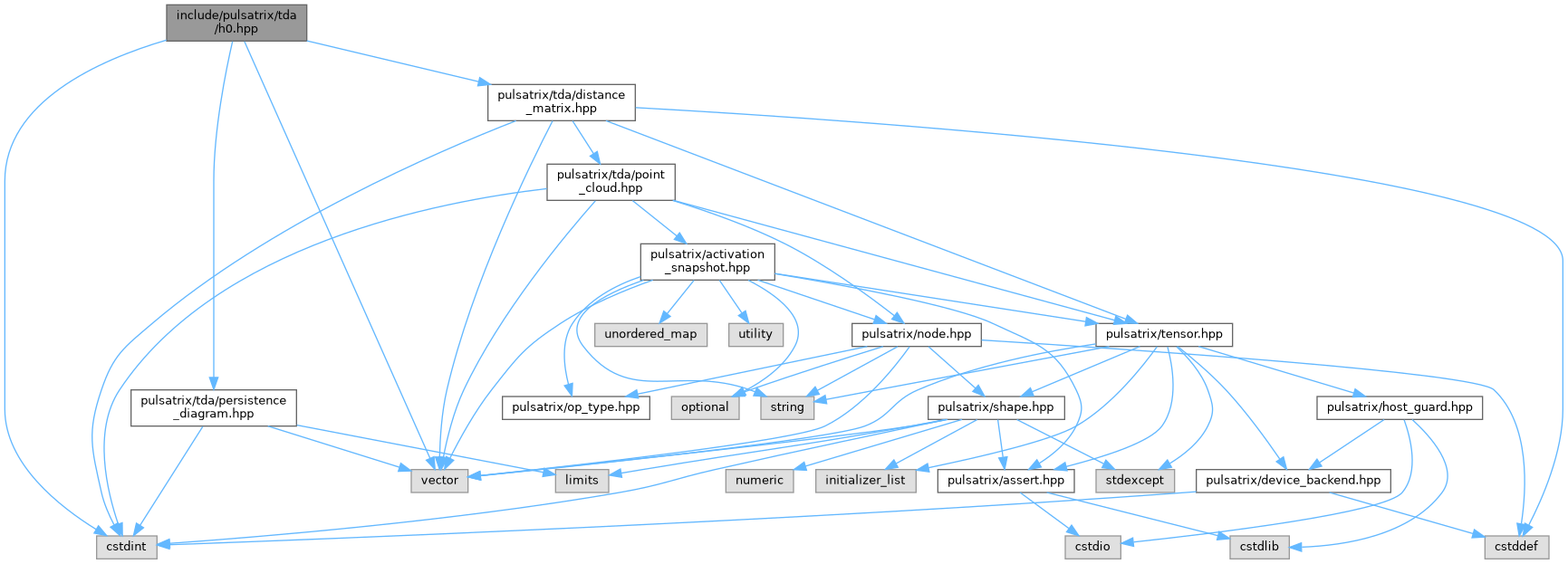
Go to the source code of this file.
Classes | |
| struct | pulsatrix::MstEdge |
| One edge of a minimum spanning tree. More... | |
| struct | pulsatrix::H0Result |
| ComputeH0()'s result. More... | |
Namespaces | |
| namespace | pulsatrix |
Functions | |
| H0Result | pulsatrix::ComputeH0 (const DistanceMatrix &distances) |
| H0 persistence of the Vietoris-Rips filtration on the given distances. | |
| std::vector< int64_t > | pulsatrix::SingleLinkageClusters (const std::vector< MstEdge > &edges, int64_t points, double threshold) |
| The clusters of single linkage cut at a scale: points joined by tree edges no longer than threshold share a label. | |
H0 persistence, the clusters of a point cloud across scales, from its minimum spanning tree.
In the Vietoris-Rips filtration every point is a component at scale 0, and two components merge when the shortest edge between them appears. That is single-linkage clustering, and the merge scales are the edge lengths of a minimum spanning tree (Carlsson and Memoli, JMLR 2010, show single linkage is the one stable clustering of this kind). So H0 needs no boundary matrices: Prim's algorithm on the distance matrix gives it exactly, in O(n^2) time and O(n) extra memory.
H0 only sees the tree. Research notes for this epic warn that many recent "LLM topology" results use H0 alone; check such a result against plain nearest-neighbor statistics (nearest_neighbors.hpp), which see much of the same thing.
 1.9.8