PULSATRIX_REQUIRE_HOST – always-on guard for code paths that dereference Tensor::data() on the host.
More...
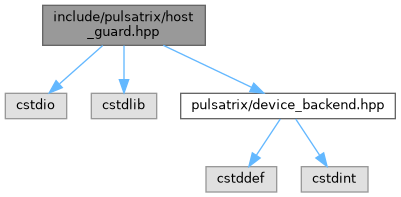
#include <cstdio>
#include <cstdlib>
#include "pulsatrix/device_backend.hpp"
Go to the source code of this file.
|
| #define | PULSATRIX_REQUIRE_HOST(tensor) |
| | Aborts if tensor is not Cpu-resident. Unlike PULSATRIX_ASSERT this is NOT compiled out under NDEBUG.
|
| |
PULSATRIX_REQUIRE_HOST – always-on guard for code paths that dereference Tensor::data() on the host.
◆ PULSATRIX_REQUIRE_HOST
| #define PULSATRIX_REQUIRE_HOST |
( |
|
tensor | ) |
|
Value: do { \
std::fprintf(stderr, \
"PULSATRIX_ASSERT failed: PULSATRIX_REQUIRE_HOST(%s): host-only code path " \
"reached with a non-Cpu tensor at %s:%d\n", \
#tensor, __FILE__, __LINE__); \
std::abort(); \
} \
} while (0)
Aborts if tensor is not Cpu-resident. Unlike PULSATRIX_ASSERT this is NOT compiled out under NDEBUG.
- Note
- A host loop over a Cuda/Hip tensor's buffer is not a recoverable contract violation but undefined behaviour (a device pointer dereferenced on the host), so the check has to survive Release builds – PULSATRIX_ASSERT, which these guards used before the GPU-native-kernels campaign, silently vanished there. The cost is one enum compare per guarded call.
-
The message keeps the "PULSATRIX_ASSERT failed" prefix so the existing guard death tests, which match on it, keep working unchanged.
-
Each remaining use marks a path still awaiting a device kernel (or a deliberate host boundary such as an RL environment); the campaign's exit gate is zero uses outside documented host-boundary code.


 1.9.8
1.9.8