 |
pulsatrix
|
|
pulsatrix
|
Hyperband (Li, Jamieson, DeSalvo, Rostamizadeh, Talwalkar, JMLR 2018): runs several Successive Halving "brackets" with different (num_configs, initial_budget) trade-offs – covering the tension between "few configs trained long" and "many configs trained short, halved down" that a single Successive Halving run commits to in advance – and returns the best result across every bracket. More...
#include <cmath>#include <limits>#include <stdexcept>#include <vector>#include "pulsatrix/successive_halving.hpp"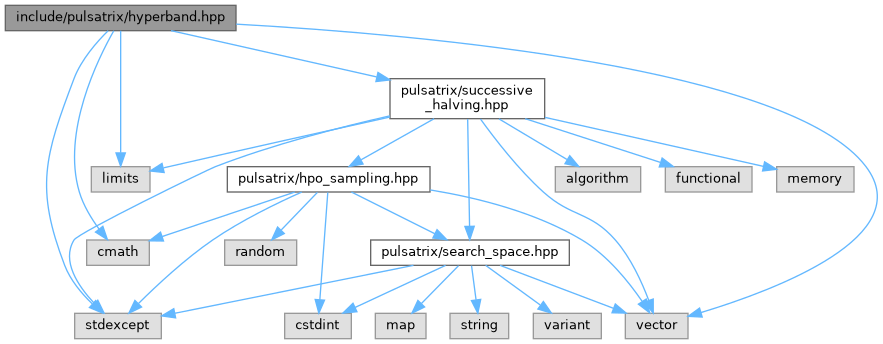
Go to the source code of this file.
Classes | |
| struct | pulsatrix::HyperbandBracket |
| One bracket's own (num_configs, initial_budget) trade-off point; s is the bracket index (s_max = most configs/smallest budget, down to s=0 = fewest configs/largest budget, matching the original paper's own naming). More... | |
| struct | pulsatrix::HyperbandResult |
| The best configuration/metric found across every bracket, and the total epoch budget spent summed across all of them. More... | |
Namespaces | |
| namespace | pulsatrix |
Functions | |
| std::vector< HyperbandBracket > | pulsatrix::ComputeHyperbandBrackets (int max_resource, double eta) |
| Computes the classic Hyperband bracket schedule: s_max = floor(log_eta(max_resource)), B = (s_max + 1) * max_resource; for s from s_max down to 0, num_configs = ceil((B / max_resource) * (eta^s / (s + 1))), initial_budget = round(max_resource / eta^s) (each floored at 1). | |
| template<typename RNG > | |
| HyperbandResult | pulsatrix::RunHyperband (const SearchSpace &space, const TrialFactory &make_trial, int max_resource, double eta, RNG &rng) |
| Runs one Successive Halving bracket (successive_halving.hpp) per ComputeHyperbandBrackets(max_resource, eta), keeping the best result across all of them. | |
Hyperband (Li, Jamieson, DeSalvo, Rostamizadeh, Talwalkar, JMLR 2018): runs several Successive Halving "brackets" with different (num_configs, initial_budget) trade-offs – covering the tension between "few configs trained long" and "many configs trained short, halved down" that a single Successive Halving run commits to in advance – and returns the best result across every bracket.
 1.9.8
1.9.8