 |
pulsatrix
|
|
pulsatrix
|
Small dense decompositions on the host: symmetric eigensolver, power iteration, QR and SVD (roadmap FND-4). More...
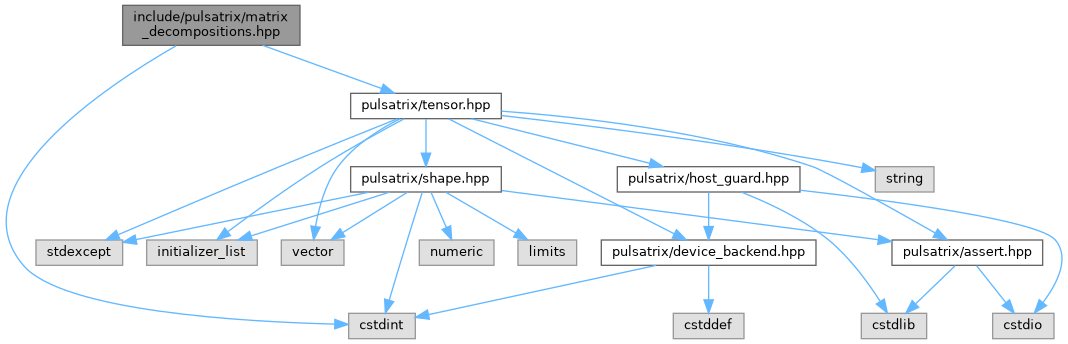
Go to the source code of this file.
Classes | |
| struct | pulsatrix::EigenResult |
| SymmetricEigen()'s result. More... | |
| struct | pulsatrix::DominantEigenResult |
| PowerIteration()'s result. More... | |
| struct | pulsatrix::QRResult |
| QR()'s result, the thin factorization A = Q R. More... | |
| struct | pulsatrix::SVDResult |
| SVD()'s result, the thin factorization A = U diag(S) V^T with k = min(m, n). More... | |
Namespaces | |
| namespace | pulsatrix |
Functions | |
| EigenResult | pulsatrix::SymmetricEigen (const Tensor &a) |
| All eigenvalues and eigenvectors of a symmetric matrix, by Householder reduction to tridiagonal form followed by QL with implicit shifts. | |
| DominantEigenResult | pulsatrix::PowerIteration (const Tensor &a, int64_t max_iterations=1000, float tolerance=1e-6f, uint64_t seed=0) |
| The dominant eigenpair of a symmetric matrix by power iteration – cheaper than SymmetricEigen() when only the top eigenpair is needed (spectral norm, stable rank). | |
| QRResult | pulsatrix::QR (const Tensor &a) |
| Thin QR factorization by Householder reflections. | |
| SVDResult | pulsatrix::SVD (const Tensor &a) |
| Thin singular value decomposition by one-sided (Hestenes) Jacobi rotations. | |
Small dense decompositions on the host: symmetric eigensolver, power iteration, QR and SVD (roadmap FND-4).
 1.9.8
1.9.8