 |
pulsatrix
|
|
pulsatrix
|
Population Based Training (Jaderberg et al. 2017, "Population Based Training of Neural Networks"): a population of live, incrementally-trained trials periodically truncation-selected – the bottom fraction exploits (copies weights and hyperparameters from a uniformly-randomly-chosen top performer) then explores (perturbs the copied hyperparameters) – producing a hyperparameter schedule (different effective hyperparameters at different points in training) rather than a single fixed configuration. More...
#include <algorithm>#include <cmath>#include <map>#include <memory>#include <numeric>#include <random>#include <stdexcept>#include <variant>#include <vector>#include "pulsatrix/pbt_trial.hpp"#include "pulsatrix/search_space.hpp"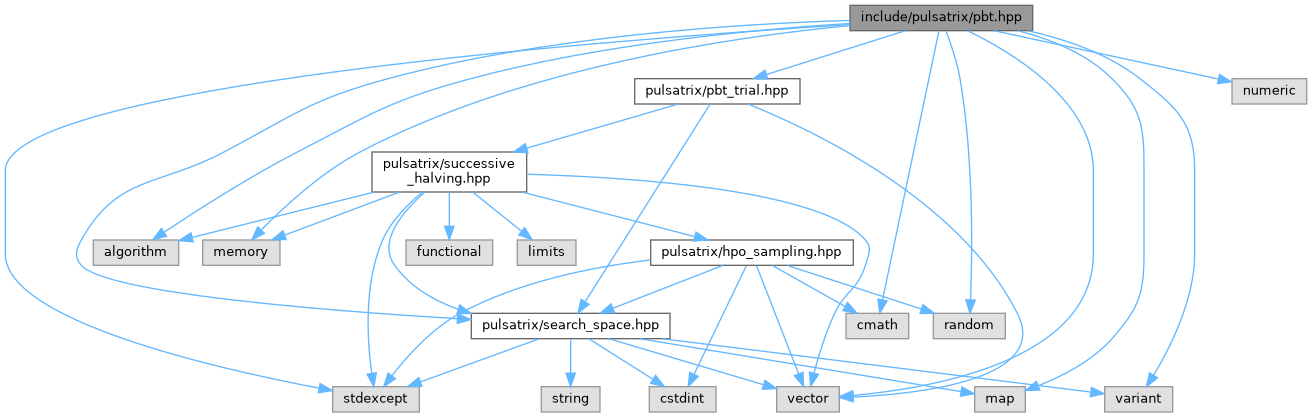
Go to the source code of this file.
Classes | |
| struct | pulsatrix::PBTTruncationGroups |
| Indices of the population's current worst- and best-performing members. More... | |
| struct | pulsatrix::PBTResult |
| The best-performing trial's index, its metric, and how many generations ran. More... | |
Namespaces | |
| namespace | pulsatrix |
Functions | |
| PBTTruncationGroups | pulsatrix::ComputeTruncationGroups (const std::vector< double > &metrics, double truncation_fraction) |
| Pure core: identifies the bottom and top truncation_fraction of the population by metric (higher is better). Ties are broken by a stable sort on descending metric, so the earlier index among equal values sorts toward "top." At least one individual is always selected on each end, even if floor(size*fraction) would be 0. | |
| Configuration | pulsatrix::ExploreConfigurationGivenFactors (const Configuration &config, const SearchSpace &space, const std::map< std::string, double > &factors) |
| Pure core: applies an explicit per-parameter multiplicative factor to every Continuous/LogUniform/Integer parameter in config, clamped to that parameter's own bounds – PBT's own "explore" step (Jaderberg et al.'s own simple perturbation: multiply by 0.8 or 1.2). Categorical parameters are left unchanged (explore, in its original form, perturbs numeric hyperparameters only – a deliberate, logged scope decision, not an oversight). Integer results are rounded to the nearest integer. | |
| template<typename RNG > | |
| Configuration | pulsatrix::ExploreConfiguration (const Configuration &config, const SearchSpace &space, RNG &rng) |
| RNG-driven wrapper: draws each non-categorical parameter's factor uniformly from {0.8, 1.2} (Jaderberg et al.'s own standard explore perturbation), then applies ExploreConfigurationGivenFactors. | |
| template<typename RNG > | |
| std::vector< double > | pulsatrix::RunPBTGeneration (std::vector< std::unique_ptr< PBTResumableTrial > > &trials, const SearchSpace &space, int num_epochs, double truncation_fraction, RNG &rng) |
| Runs one PBT generation: trains every live trial for num_epochs, then exploits+explores the bottom truncation_fraction of the population from a uniformly-randomly-chosen member of the top truncation_fraction. Individuals outside both groups are left running untouched. Returns each trial's metric as of this generation (post exploit/explore for any trial that was replaced) – the value to feed into the next generation's own truncation. | |
| template<typename RNG > | |
| PBTResult | pulsatrix::RunPBT (std::vector< std::unique_ptr< PBTResumableTrial > > &trials, const SearchSpace &space, int num_generations, int epochs_per_generation, double truncation_fraction, RNG &rng) |
| Runs num_generations of RunPBTGeneration in sequence. | |
Population Based Training (Jaderberg et al. 2017, "Population Based Training of Neural Networks"): a population of live, incrementally-trained trials periodically truncation-selected – the bottom fraction exploits (copies weights and hyperparameters from a uniformly-randomly-chosen top performer) then explores (perturbs the copied hyperparameters) – producing a hyperparameter schedule (different effective hyperparameters at different points in training) rather than a single fixed configuration.
 1.9.8
1.9.8