 |
pulsatrix 1.1.0
|
|
pulsatrix 1.1.0
|
Principal component analysis of a layer's representations (INT-5): 2D and 3D views, directions to steer along, and fewer dimensions for what comes after. More...
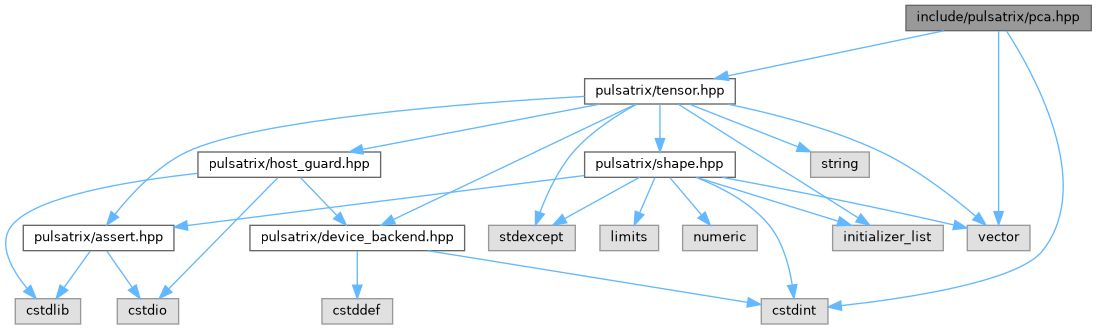
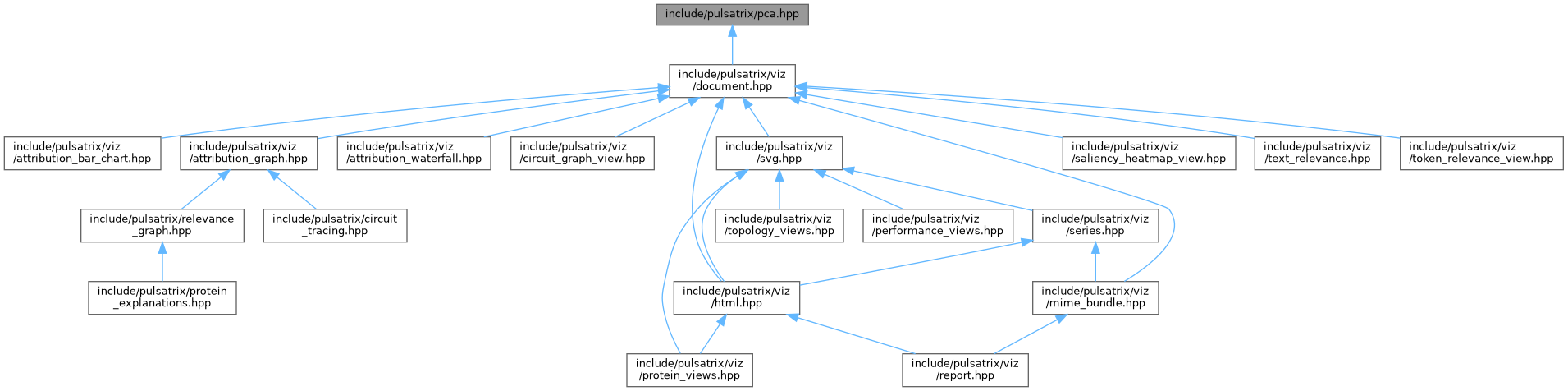
Go to the source code of this file.
Classes | |
| struct | pulsatrix::Pca |
| A fitted PCA. More... | |
Namespaces | |
| namespace | pulsatrix |
Functions | |
| Pca | pulsatrix::FitPca (const Tensor &x, int64_t components, bool center=true) |
Fits the components directions of most variance. | |
| Tensor | pulsatrix::PcaProject (const Pca &pca, const Tensor &x, bool whiten=false) |
Each row's coordinates on the components: (x - mean) components^T, shape (n, components), on x's backend. | |
| Tensor | pulsatrix::PcaReconstruct (const Pca &pca, const Tensor &scores) |
The rows that coordinates map back to: mean + scores components, shape (n, width). Projecting and reconstructing keeps only what the components hold. | |
| std::vector< float > | pulsatrix::PcaComponent (const Pca &pca, int64_t index) |
Component index as a unit vector of floats, for SteeringHook(). One standard deviation along it is sqrt(explained_variance[index]), a natural unit for the coefficient. | |
| double | pulsatrix::SubspaceOverlap (const Pca &a, const Pca &b, int64_t k) |
How much two PCAs' first k components span the same space: the mean squared cosine of the principal angles between them, |A_k B_k^T|_F^2 / k. 1 when the spans are the same (whatever the order or rotation inside them), 0 when they are orthogonal, and about k / width for unrelated random subspaces. | |
| double | pulsatrix::PcaSplitHalfOverlap (const Tensor &x, int64_t k, uint64_t seed=0) |
Fits k components on each half of the rows, split at random, and returns their SubspaceOverlap(). Near 1 means the k-dimensional picture is a property of the data; well below 1 means it depends on which inputs happened to be drawn. | |
Principal component analysis of a layer's representations (INT-5): 2D and 3D views, directions to steer along, and fewer dimensions for what comes after.
FitPca() finds the directions along which a set of inputs' representations vary most. PcaProject() places inputs on them, for a scatter plot (viz/projection.hpp) or as input to methods that want fewer dimensions. PcaComponent() gives a direction as a steering vector.
It matches scikit-learn's PCA (the full solver): the data are centered, variances divide by n - 1, and each component's sign makes its largest-magnitude entry positive, so the same data always give the same picture. Everything is in double precision on the host, through the covariance (width x width) or the Gram matrix (n x n), whichever is smaller.
Two cautions. Components whose variances are close can swap or rotate between two samples of the same data, so a 2D picture isn't always stable: PcaSplitHalfOverlap() checks. And the largest directions of variance aren't necessarily the ones the model uses: a direction found here is a hypothesis to test, for example by steering along it.
 1.9.8