 |
pulsatrix 1.1.0
|
|
pulsatrix 1.1.0
|
The input to topological data analysis: a layer's activations as a set of points, one row per input or per position, gathered across batches. More...
#include <cstdint>#include <vector>#include "pulsatrix/activation_snapshot.hpp"#include "pulsatrix/node.hpp"#include "pulsatrix/tensor.hpp"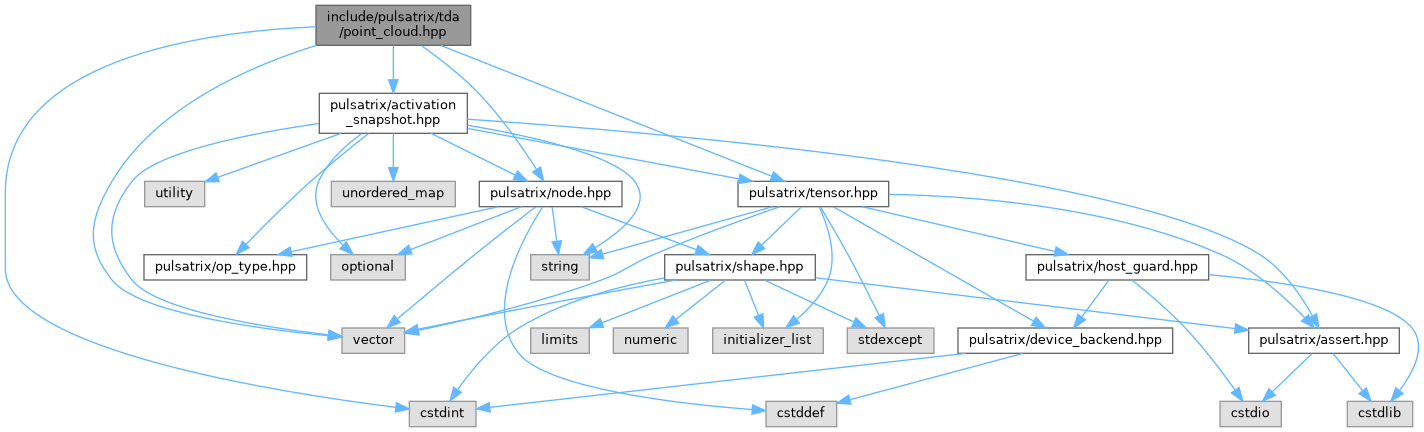
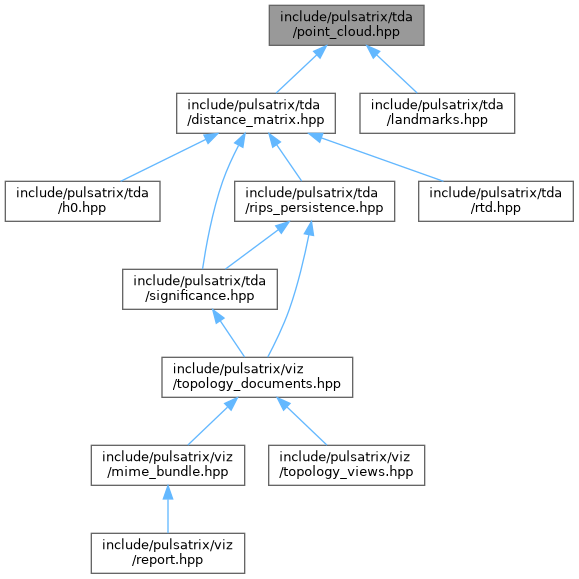
Go to the source code of this file.
Classes | |
| struct | pulsatrix::PointCloudOptions |
| PointCloud's settings. More... | |
| struct | pulsatrix::PointOrigin |
| Where one point of a PointCloud came from. More... | |
| class | pulsatrix::PointCloud |
| A set of points in R^dimension, built from activation batches. More... | |
Namespaces | |
| namespace | pulsatrix |
Enumerations | |
| enum class | pulsatrix::PointPooling { pulsatrix::Flatten , pulsatrix::PerPosition , pulsatrix::Mean , pulsatrix::Max , pulsatrix::Last } |
| How PointCloud turns one sample's activations into points. More... | |
Functions | |
| PointCloud | pulsatrix::MakePointCloud (const std::vector< ActivationSnapshot > &snapshots, NodeId node, PointCloudOptions options={}) |
| A cloud from one node of several forward passes, such as one snapshot per batch. | |
The input to topological data analysis: a layer's activations as a set of points, one row per input or per position, gathered across batches.
Persistent homology measures the shape of a finite set of points. A layer's activations come as batches of tensors, (batch, ...), from ActivationSnapshot or a model's hooks. PointCloud turns those batches into one (n, dimension) set of points, and records where each point came from, so a loop or a cluster found later can be traced back to the inputs and positions that form it.
How a sample becomes points is the one choice to make (PointPooling):
 1.9.8