 |
pulsatrix 1.1.0
|
|
pulsatrix 1.1.0
|
Explaining by example (XAI-4): the background inputs nearest one input that the model treats the same way and differently, and ProtoDash's weighted prototypes that summarize a dataset (Gurumoorthy, Dhurandhar, Cecchi and Aggarwal, ICDM 2019). More...
#include <cstdint>#include <functional>#include <vector>#include "pulsatrix/json.hpp"#include "pulsatrix/tensor.hpp"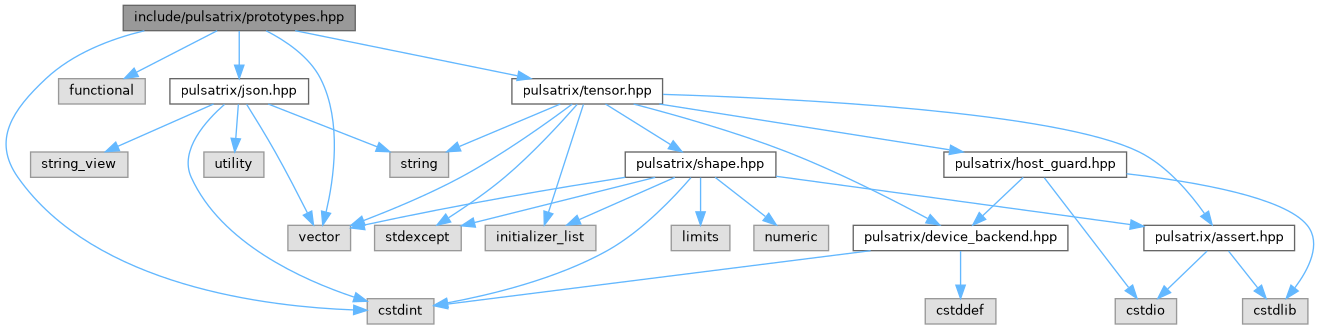
Go to the source code of this file.
Classes | |
| struct | pulsatrix::PrototypeOptions |
| FindPrototypes()' settings. More... | |
| struct | pulsatrix::Example |
| One background example. More... | |
| struct | pulsatrix::PrototypeResult |
| FindPrototypes()' result. More... | |
| struct | pulsatrix::ProtoDashOptions |
| ProtoDash()'s settings. More... | |
| struct | pulsatrix::ProtoDashResult |
| ProtoDash()'s result. More... | |
Namespaces | |
| namespace | pulsatrix |
Typedefs | |
| using | pulsatrix::EmbedFn = std::function< std::vector< float >(const Tensor &input)> |
| Maps an input to the vector distances are measured in. | |
Functions | |
| PrototypeResult | pulsatrix::FindPrototypes (const std::function< Tensor(const Tensor &)> &predict, const Tensor &input, const std::vector< Tensor > &background, const PrototypeOptions &options={}) |
The background examples nearest input that the model classes the same way, and those it classes differently. Classes are the index of the model's largest output. | |
| ProtoDashResult | pulsatrix::ProtoDash (const std::vector< Tensor > &source, const std::vector< Tensor > &target, const ProtoDashOptions &options={}) |
ProtoDash: chooses up to options.count points of source, with weights, whose weighted kernel mean best matches the kernel mean of target (an MMD criterion). | |
| JsonValue | pulsatrix::ToJson (const PrototypeResult &result) |
The result as a pulsatrix.prototypes.v1 document. | |
Explaining by example (XAI-4): the background inputs nearest one input that the model treats the same way and differently, and ProtoDash's weighted prototypes that summarize a dataset (Gurumoorthy, Dhurandhar, Cecchi and Aggarwal, ICDM 2019).
"This input is classed like these, and unlike those" is often easier to check than a heatmap. The nearest same-class examples are the input's prototypes; the nearest examples of another class are its contrasts, the closest cases where the model decided differently.
Distances are Euclidean, either in the input space with a per-feature scale (pass MedianAbsoluteDeviation() for tabular data in mixed units) or in a representation the caller computes, such as a layer's activations.
 1.9.8