 |
pulsatrix 1.1.0
|
|
pulsatrix 1.1.0
|
Local sensitivity: one-at-a-time input changes and occlusion (CFS-3). More...
#include <cstdint>#include <functional>#include <vector>#include "pulsatrix/attribution.hpp"#include "pulsatrix/tensor.hpp"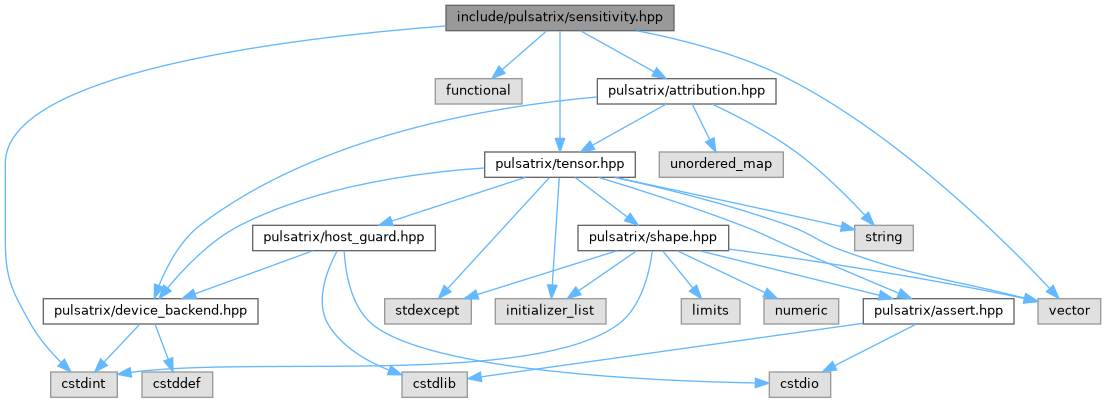
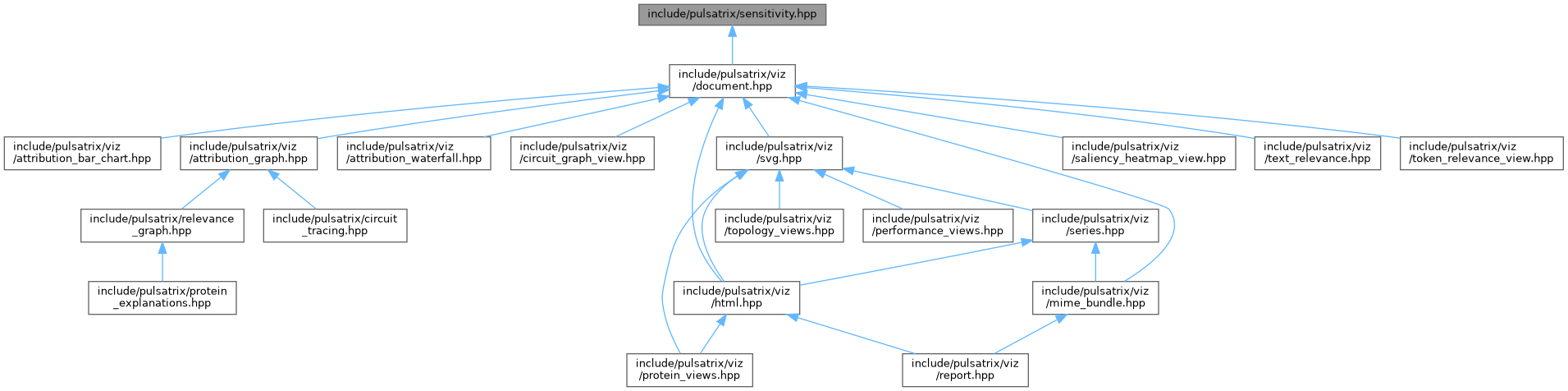
Go to the source code of this file.
Classes | |
| struct | pulsatrix::SensitivityBounds |
| The low and high value to try for every feature of an input (flat order). More... | |
| struct | pulsatrix::FeatureSensitivity |
| How one feature's low and high value move the output, everything else held fixed. More... | |
| struct | pulsatrix::LocalSensitivityResult |
| One-at-a-time sensitivity of one output around one input. More... | |
Namespaces | |
| namespace | pulsatrix |
Functions | |
| SensitivityBounds | pulsatrix::DeltaBounds (const Tensor &input, float delta) |
| x - delta and x + delta for every feature. | |
| SensitivityBounds | pulsatrix::ScaledDeltaBounds (const Tensor &input, const std::vector< Tensor > &background, float num_std=1.0f) |
x -/+ num_std standard deviations of each feature over background, so every feature moves by a comparable amount whatever its units. A feature constant over the background doesn't move. | |
| SensitivityBounds | pulsatrix::RangeBounds (const std::vector< Tensor > &background, float lower_percentile=0.05f, float upper_percentile=0.95f) |
Each feature's lower and upper percentile over background (linear interpolation, as numpy.percentile): the classic tornado-diagram range, a typical low and high value. | |
| LocalSensitivityResult | pulsatrix::ComputeLocalSensitivity (const std::function< Tensor(const Tensor &)> &predict, const Tensor &input, int64_t target_index, const SensitivityBounds &bounds, const std::vector< int64_t > &features={}) |
| Sets each feature in turn to its low and then its high bound, leaving the others at the input's values, and records the target output each time. | |
| Attribution | pulsatrix::Occlusion (const std::function< Tensor(const Tensor &)> &predict, const Tensor &input, int64_t target_index, const std::vector< int64_t > &window, const std::vector< int64_t > &strides, float baseline=0.0f) |
Occlusion (Zeiler and Fergus 2014) with Captum 0.9's semantics: a window slides over the input with the given strides, everything under it is set to baseline, and each element's attribution is the drop in the target output, f(x) - f(occluded), averaged over the windows that covered it. | |
Local sensitivity: one-at-a-time input changes and occlusion (CFS-3).
 1.9.8