 |
pulsatrix 1.1.0
|
|
pulsatrix 1.1.0
|
Is a loop real? Significance tests for persistence diagrams: the universal null distribution, bootstrap confidence bands, and baseline comparisons against Gaussian clouds or a random network. More...
#include <cstdint>#include <vector>#include "pulsatrix/tda/distance_matrix.hpp"#include "pulsatrix/tda/persistence_diagram.hpp"#include "pulsatrix/tda/rips_persistence.hpp"#include "pulsatrix/tensor.hpp"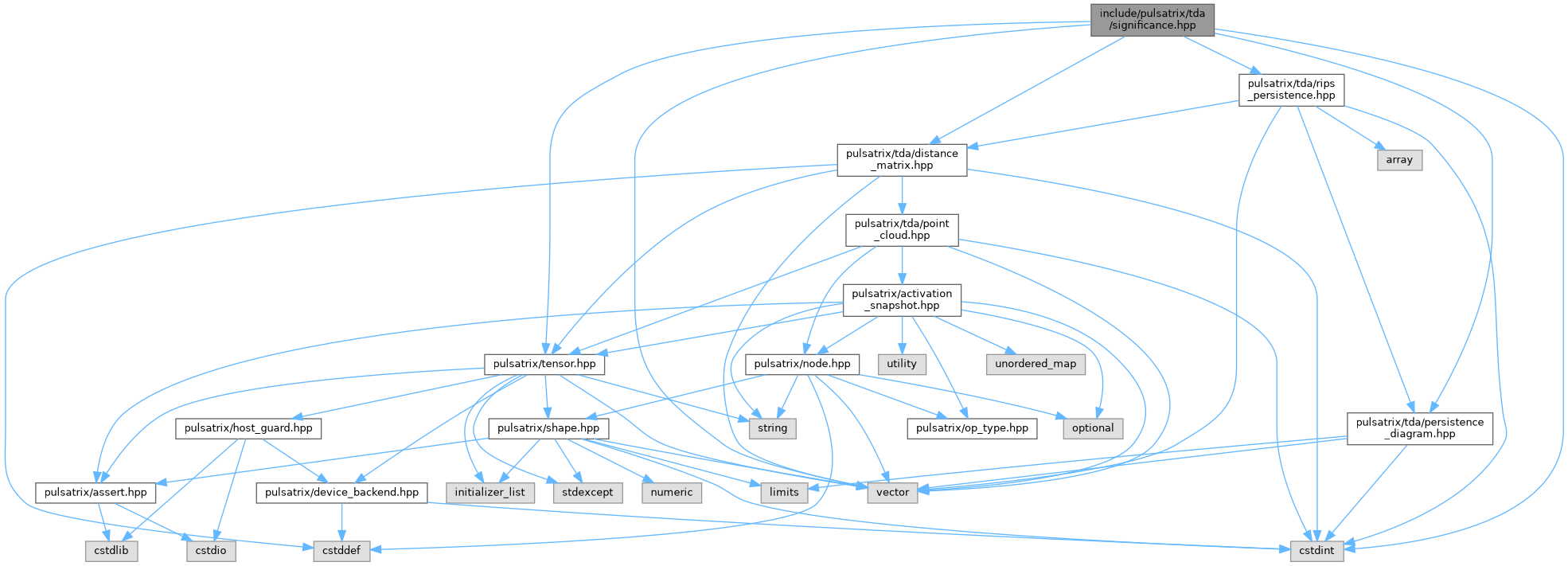
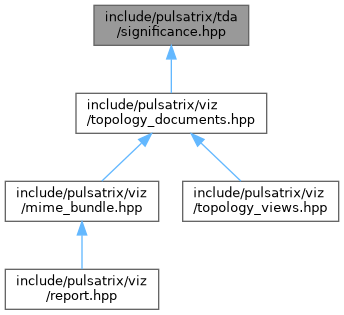
Go to the source code of this file.
Classes | |
| struct | pulsatrix::FeatureSignificance |
| One feature's result in UniversalNullTest(). More... | |
| struct | pulsatrix::UniversalNullResult |
| UniversalNullTest()'s result. More... | |
| struct | pulsatrix::BootstrapOptions |
| BootstrapBand()'s settings. More... | |
| struct | pulsatrix::BootstrapBandResult |
| BootstrapBand()'s result. More... | |
Namespaces | |
| namespace | pulsatrix |
Functions | |
| UniversalNullResult | pulsatrix::UniversalNullTest (const PersistenceDiagram &diagram, double alpha=0.05) |
| Bobrowski and Skraba's universal null test for every feature of a Vietoris-Rips diagram in dimension 1 or above: ell = log log(death / birth) - L-bar - (Euler-Mascheroni's constant), compared with the left-skewed Gumbel, whose survival function is exp(-e^ell). | |
| BootstrapBandResult | pulsatrix::BootstrapBand (const DistanceMatrix &distances, int dimension, const BootstrapOptions &options={}) |
| A bootstrap confidence band for a Rips diagram (after Fasy, Lecci, Rinaldo, Wasserman, Balakrishnan and Singh, Ann. Statist. 2014): resample the points with replacement, compute each resample's diagram, and take the (1 - alpha) quantile of their bottleneck distances to the original. | |
| Tensor | pulsatrix::GaussianBaseline (const Tensor &points, int64_t count, uint32_t seed=0) |
| count points from a Gaussian with the mean and sample covariance of the rows of points: mu + Z^T (X - mu) / sqrt(n - 1) with Z standard normal (one GEMM on points' backend), so no decomposition of the covariance is needed and its rank is kept. | |
| double | pulsatrix::BaselinePValue (double observed, const std::vector< double > &baselines) |
| The rank p-value of an observed statistic against the same statistic on baselines: (1 + #{baseline >= observed}) / (1 + baselines.size()). Small means the observed value is larger than chance gives; the smallest possible is 1 / (1 + baselines.size()). | |
| double | pulsatrix::MaxPersistence (const PersistenceDiagram &diagram) |
| The largest finite persistence in a diagram, 0 if it has none: a common statistic for BaselinePValue(). | |
| DistanceMatrix | pulsatrix::SubDistanceMatrix (const DistanceMatrix &distances, const std::vector< int64_t > &indices) |
| A sub-matrix of a distance matrix: the distances among the given points (repeats allowed), in the given order. | |
Is a loop real? Significance tests for persistence diagrams: the universal null distribution, bootstrap confidence bands, and baseline comparisons against Gaussian clouds or a random network.
A persistence diagram of noise is full of short-lived features, and a few of them always live longer than the rest. Every reported feature needs a test that says how surprising it is:
 1.9.8