 |
pulsatrix 1.1.0
|
|
pulsatrix 1.1.0
|
Steering a model by adding a direction to its residual stream (FEAT-7), with difference-of-means as the default direction, a featurizer's decoder direction as an option, and a report on how reliably steering works. More...
#include <cstdint>#include <functional>#include <vector>#include "pulsatrix/causal_lm.hpp"#include "pulsatrix/featurizer.hpp"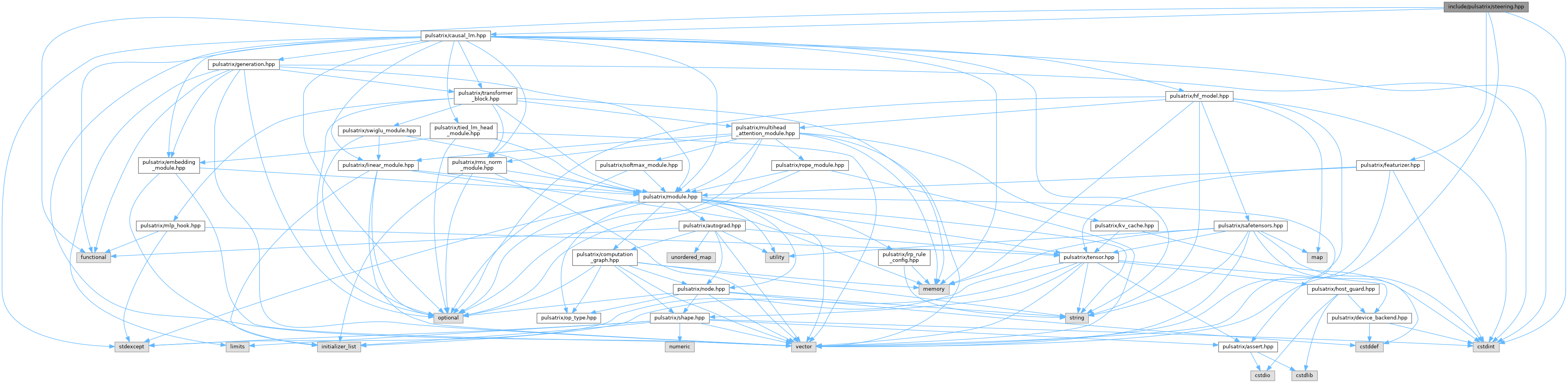
Go to the source code of this file.
Classes | |
| struct | pulsatrix::SteeringOptions |
| struct | pulsatrix::SteeringReport |
| MeasureSteering()'s result. More... | |
Namespaces | |
| namespace | pulsatrix |
Functions | |
| std::vector< float > | pulsatrix::DifferenceOfMeans (const std::vector< float > &positive, const std::vector< float > &negative, int64_t d) |
The difference of means: the mean of positive minus the mean of negative, both (N, d) row-major. The simple baseline that usually wins. | |
| std::vector< float > | pulsatrix::FeaturizerDirection (Featurizer &featurizer, int64_t feature) |
Feature feature's decoder direction, as a steering direction (unit length for a featurizer with unit-norm decoders). | |
| HiddenStateHook | pulsatrix::SteeringHook (int64_t position, std::vector< float > direction, float coefficient, std::vector< bool > rows={}) |
A hook that adds coefficient * direction to the hidden states at position (0 is the embeddings, i layer i's output), for the rows in rows (every row when empty). Install it with CausalLM::set_hidden_state_hook() or EncoderLM::set_hidden_state_hook(). | |
| SteeringReport | pulsatrix::MeasureSteering (const std::function< double(int64_t i, const HiddenStateHook &hook)> &behavior, int64_t num_inputs, int64_t position, const std::vector< float > &direction, const SteeringOptions &options={}) |
Measures steering along direction, and along random directions of the same norm. | |
Steering a model by adding a direction to its residual stream (FEAT-7), with difference-of-means as the default direction, a featurizer's decoder direction as an option, and a report on how reliably steering works.
 1.9.8