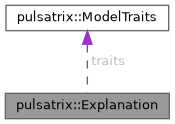
An explanation and what it does and doesn't support (XAI-3).
More...
#include <explanation_report.hpp>
|
| bool | supports_reason () const |
| | Whether nothing blocks using it for its reason.
|
| |
| const CheckResult * | check (std::string_view name) const |
| | The result of the check named name, or nullptr.
|
| |
| std::optional< std::string > | setting (std::string_view key) const |
| | The value of setting key, or std::nullopt.
|
| |
|
| XaiQuestion | question = XaiQuestion::Why |
| |
| XaiReason | reason = XaiReason::Justify |
| |
| ModelTraits | traits |
| |
| std::string | method |
| | The catalog name of the explainer: "IntegratedGradients".
|
| |
| int | plan_rank = 0 |
| | Its place in the plan for this question, reason and model, from 1; 0 if the planner excluded it, and then excluded_reason says why.
|
| |
| std::string | excluded_reason |
| |
| std::optional< Attribution > | attribution |
| | What the explainer returned; empty for explainers that don't return an attribution.
|
| |
| std::vector< std::pair< std::string, std::string > > | settings |
| | The explainer's metadata, sorted by key, then the caller's settings, then the checks' own settings under "check.": everything needed to reproduce it.
|
| |
| std::vector< std::pair< std::string, double > > | metrics |
| | Properties of the attribution itself: "sparseness" and "complexity".
|
| |
| std::vector< CheckResult > | checks |
| | One result per check the plan asks for, required first, plus any extra checks the caller ran.
|
| |
| std::optional< Attribution > | aggregate |
| | The mean absolute attribution over the dataset, when the aggregate check ran.
|
| |
| std::vector< Caveat > | caveats |
| | DeriveCaveats(*this): blocking first, then warnings, then notes.
|
| |
An explanation and what it does and doesn't support (XAI-3).
◆ check()
| const CheckResult * pulsatrix::Explanation::check |
( |
std::string_view |
name | ) |
const |
The result of the check named name, or nullptr.
◆ setting()
| std::optional< std::string > pulsatrix::Explanation::setting |
( |
std::string_view |
key | ) |
const |
The value of setting key, or std::nullopt.
◆ supports_reason()
| bool pulsatrix::Explanation::supports_reason |
( |
| ) |
const |
Whether nothing blocks using it for its reason.
◆ aggregate
| std::optional<Attribution> pulsatrix::Explanation::aggregate |
The mean absolute attribution over the dataset, when the aggregate check ran.
◆ attribution
| std::optional<Attribution> pulsatrix::Explanation::attribution |
What the explainer returned; empty for explainers that don't return an attribution.
◆ caveats
| std::vector<Caveat> pulsatrix::Explanation::caveats |
DeriveCaveats(*this): blocking first, then warnings, then notes.
◆ checks
| std::vector<CheckResult> pulsatrix::Explanation::checks |
One result per check the plan asks for, required first, plus any extra checks the caller ran.
◆ excluded_reason
| std::string pulsatrix::Explanation::excluded_reason |
◆ method
| std::string pulsatrix::Explanation::method |
The catalog name of the explainer: "IntegratedGradients".
◆ metrics
| std::vector<std::pair<std::string, double> > pulsatrix::Explanation::metrics |
Properties of the attribution itself: "sparseness" and "complexity".
◆ plan_rank
| int pulsatrix::Explanation::plan_rank = 0 |
Its place in the plan for this question, reason and model, from 1; 0 if the planner excluded it, and then excluded_reason says why.
◆ question
◆ reason
◆ settings
| std::vector<std::pair<std::string, std::string> > pulsatrix::Explanation::settings |
The explainer's metadata, sorted by key, then the caller's settings, then the checks' own settings under "check.": everything needed to reproduce it.
◆ traits
The documentation for this struct was generated from the following file:

 1.9.8