 |
pulsatrix 1.1.0
|
|
pulsatrix 1.1.0
|
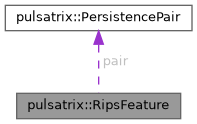
One feature of the diagram, with where it comes from. More...
#include <rips_persistence.hpp>
Public Attributes | |
| PersistencePair | pair |
| Its birth and death. | |
| std::array< int64_t, 2 > | birth_edge {{-1, -1}} |
| The edge whose length is the birth: the longest edge of the simplex that creates the feature, endpoints in increasing order. {-1, -1} in H0, where a point creates it. | |
| std::array< int64_t, 2 > | death_edge {{-1, -1}} |
| The edge whose length is the death: the longest edge of the simplex that kills it. {-1, -1} for an essential feature. In H0, the edge that merges two components. | |
| std::vector< CocycleEntry > | cocycle |
| With RipsOptions::cocycles, for dimension 1 and above: a cocycle that represents the feature. Evaluated on the simplices of the complex at any scale in [birth, death), its coboundary is zero; it may also list simplices that appear later. Empty otherwise. | |
One feature of the diagram, with where it comes from.
| std::array<int64_t, 2> pulsatrix::RipsFeature::birth_edge {{-1, -1}} |
The edge whose length is the birth: the longest edge of the simplex that creates the feature, endpoints in increasing order. {-1, -1} in H0, where a point creates it.
| std::vector<CocycleEntry> pulsatrix::RipsFeature::cocycle |
With RipsOptions::cocycles, for dimension 1 and above: a cocycle that represents the feature. Evaluated on the simplices of the complex at any scale in [birth, death), its coboundary is zero; it may also list simplices that appear later. Empty otherwise.
| std::array<int64_t, 2> pulsatrix::RipsFeature::death_edge {{-1, -1}} |
The edge whose length is the death: the longest edge of the simplex that kills it. {-1, -1} for an essential feature. In H0, the edge that merges two components.
| PersistencePair pulsatrix::RipsFeature::pair |
Its birth and death.
 1.9.8