 |
pulsatrix
|
|
pulsatrix
|
Survivor-selection policies for the evolutionary-loop skeleton (evolutionary_loop.hpp): generational replacement, (mu+lambda), (mu,lambda). More...
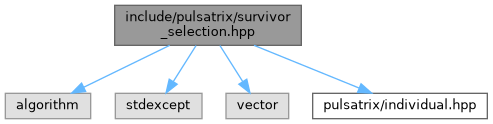
Go to the source code of this file.
Namespaces | |
| namespace | pulsatrix |
Functions | |
| template<typename Genotype , typename FitnessT > | |
| std::vector< Individual< Genotype, FitnessT > > | pulsatrix::GenerationalReplacement (const std::vector< Individual< Genotype, FitnessT > > &, std::vector< Individual< Genotype, FitnessT > > offspring, size_t mu) |
| Generational replacement (DEAP's eaSimple): the offspring pool becomes the entire next generation; population is ignored (parents never survive). | |
| template<typename Genotype , typename FitnessT > | |
| std::vector< Individual< Genotype, FitnessT > > | pulsatrix::MuPlusLambdaReplacement (const std::vector< Individual< Genotype, FitnessT > > &population, std::vector< Individual< Genotype, FitnessT > > offspring, size_t mu) |
| (mu+lambda) replacement: the next generation is the fittest mu individuals from population union offspring (parents may survive) – more exploitative than (mu,lambda), since a fit parent is never discarded just for being old. | |
| template<typename Genotype , typename FitnessT > | |
| std::vector< Individual< Genotype, FitnessT > > | pulsatrix::MuCommaLambdaReplacement (const std::vector< Individual< Genotype, FitnessT > > &, std::vector< Individual< Genotype, FitnessT > > offspring, size_t mu) |
| (mu,lambda) replacement: the next generation is the fittest mu individuals from offspring only (population/parents are always discarded) – more explorative than (mu+lambda), since it cannot get stuck re-selecting the same elite parent forever. | |
Survivor-selection policies for the evolutionary-loop skeleton (evolutionary_loop.hpp): generational replacement, (mu+lambda), (mu,lambda).
 1.9.8
1.9.8