 |
pulsatrix 1.1.0
|
|
pulsatrix 1.1.0
|
Explaining a continuous diffusion sampler end to end (DIFF-5): trajectory LRP (design D1), which seeds a scalar of the final sample x_0 once and carries its relevance back through every reverse step to the starting noise x_T, the conditioning, and named sinks. More...
#include <cstdint>#include <vector>#include "pulsatrix/lrp_rule_config.hpp"#include "pulsatrix/module.hpp"#include "pulsatrix/noise_schedule.hpp"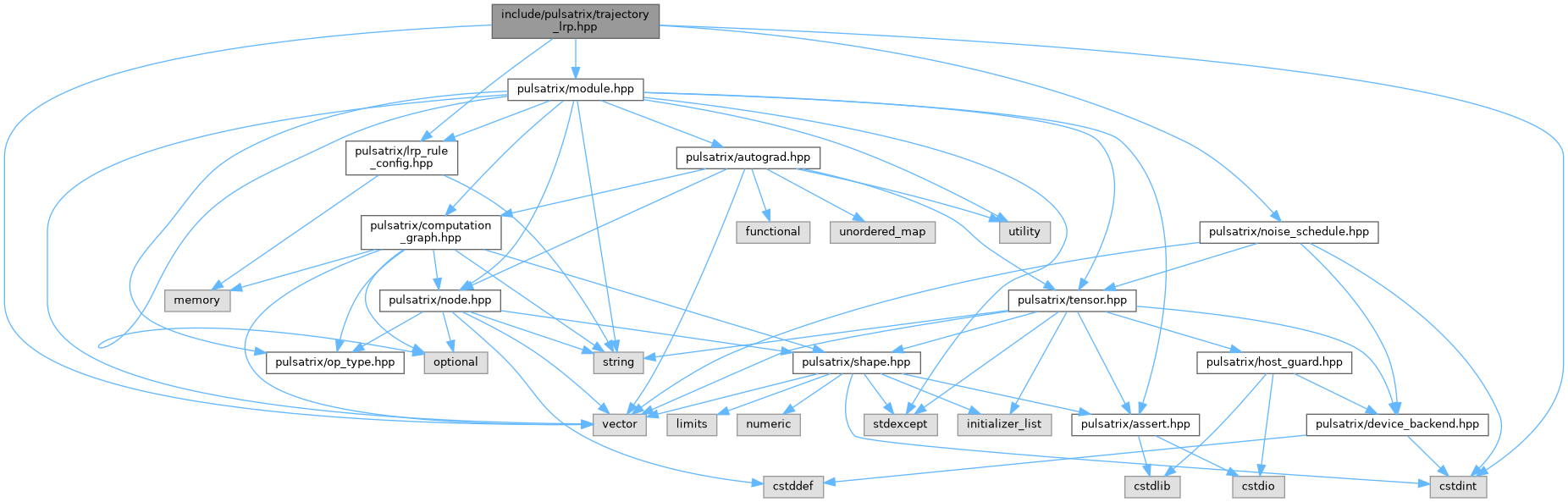
Go to the source code of this file.
Classes | |
| struct | pulsatrix::DenoiserRelevance |
| Where the network's share of one step landed. More... | |
| class | pulsatrix::ContinuousDenoiser |
| The noise predictor eps_theta as the explainer sees it, with its conditioning fixed: a forward pass that keeps what the relevance pass needs, and the relevance pass. More... | |
| class | pulsatrix::ConcatDenoiser |
A Module that reads [x_t, embedding(t), c] as one row, conditioned by concatenation as in tests/diffusion_integration_test.cpp: x_t, then a sinusoidal timestep embedding (SinusoidalTimestepEmbedding), then a fixed conditioning vector such as a one-hot class. Its input relevance is split back into those three parts. More... | |
| struct | pulsatrix::ContinuousSamplerConfig |
| struct | pulsatrix::ContinuousTrajectory |
| A reverse process, recorded so it can be explained: every state and every noise draw. More... | |
| struct | pulsatrix::TrajectoryLrpConfig |
| struct | pulsatrix::TrajectoryHop |
| One reverse step's split, aggregated over elements. More... | |
| struct | pulsatrix::TrajectoryRelevance |
| Where the seed's relevance went. The budget balances exactly: value = x_T + condition + time + noise + absorbed + leak. More... | |
Namespaces | |
| namespace | pulsatrix |
Enumerations | |
| enum class | pulsatrix::ContinuousSampler { pulsatrix::Ddpm , pulsatrix::Ddim } |
| Which reverse process to run. More... | |
| enum class | pulsatrix::TrajectorySplit { pulsatrix::AbsoluteRatio , pulsatrix::SignedEpsilon , pulsatrix::SignedRatio } |
| How the relevance on x_prev is split across skip, network and noise (h_1, h_2, h_3). More... | |
Functions | |
| LRPRuleConfig | pulsatrix::TrajectoryNetworkRules () |
The network rules ConcatDenoiser uses unless told otherwise: the epsilon rule with the bias in the denominator (Zennit's), so the biases absorb their share. The codebase's default pre-bias rule divides by x W alone, which a hidden layer's bias can leave near zero while the unit is active; chained over the steps of a sampler its relevance blew up (DIFF-5's planted DDPM: conditioning shares up to 570 times the explained value). | |
| ContinuousTrajectory | pulsatrix::SampleContinuousDiffusion (ContinuousDenoiser &model, const NoiseSchedule &schedule, const std::vector< float > &x_T, const ContinuousSamplerConfig &config) |
Runs the reverse process from x_T and records it. | |
| std::vector< float > | pulsatrix::StandardNormal (size_t n, uint64_t seed) |
Draws n standard normal values from seed, as SampleContinuousDiffusion does. | |
| std::vector< float > | pulsatrix::RegionSeed (const std::vector< float > &sample, const std::vector< int64_t > ®ion) |
The sum of sample over region: relevance x0_i on the region's elements, 0 elsewhere. | |
| std::vector< float > | pulsatrix::ReconstructionSeed (const std::vector< float > &sample, const std::vector< float > &reference) |
The reconstruction error ||x_0 - reference||^2, as LRP for autoencoders seeds it (Kobayashi et al. 2023): relevance (x0_i - ref_i)^2 on each element. | |
| TrajectoryRelevance | pulsatrix::ExplainTrajectory (ContinuousDenoiser &model, const ContinuousTrajectory &trajectory, const std::vector< float > &seed, const TrajectoryLrpConfig &config={}) |
Explains seed, relevance on the trajectory's sample x_0 (RegionSeed, ReconstructionSeed, or a downstream classifier's input relevance), back through trajectory, which SampleContinuousDiffusion produced with model. | |
Explaining a continuous diffusion sampler end to end (DIFF-5): trajectory LRP (design D1), which seeds a scalar of the final sample x_0 once and carries its relevance back through every reverse step to the starting noise x_T, the conditioning, and named sinks.
A DDPM or DDIM step is x_prev = skip * x_t - network * eps_theta(x_t, t, c) + noise * z, a residual block with a third, injected-noise term. The relevance on each element of x_prev is split across the three terms, by default keeping each term's sign (TrajectorySplit::SignedRatio). The skip share goes straight to x_t; the network share runs through eps_theta with its own LRP rules onto x_t, the conditioning c and the timestep embedding (a sink); the noise share is a sink too, exactly zero under DDIM. Only the trajectory is stored, and each step's forward pass is rerun just before its relevance pass. See docs/interpretability/diffusion-lrp.md (D1) for the derivation and its limits.
 1.9.8