pulsatrix 1.1.0
Loading...
Searching...
No Matches
pulsatrix::ActivationModule Class Reference

y = f(x), elementwise, for one of the backend's activations. No parameters. More...

#include <activation_module.hpp>

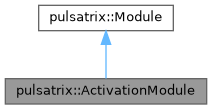
Inheritance diagram for pulsatrix::ActivationModule:
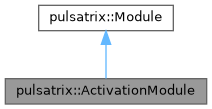
Collaboration diagram for pulsatrix::ActivationModule:

Public Member Functions

 ActivationModule (ElementwiseOp op, DeviceBackend *backend)
 
Tensor backward (const Tensor &grad_output) override
 grad_output times f'(x) at the cached input.
 
Tensor propagate_relevance (const Tensor &relevance_out, const LRPRuleConfig &config) override
 relevance_out, unchanged.
 
bool supports_lrp_rule (LRPRule) const override
 Whether propagate_relevance() implements rule (no silent fallback: callers such as ExplainerContext::relevance_pass() throw rather than run a module on a rule it does not implement).
 
OpType op_type () const override
 This module's operation-category tag, for ComputationGraph node tagging.
 
std::optional< DeviceType > compute_device () const override
 The device this module computes on, so forward() can reject an input on another device before any kernel sees it (roadmap FND-8).
 
ElementwiseOp op () const
 
void release_activations () override
 Frees the tensors forward() kept for backward() and the relevance passes; containers release their children too. Inference that only needs the output calls it after each forward, so a deep model holds one layer's activations at a time (a 1024-token ESM-2 650M pass otherwise keeps over 10 GB of them).
 
- Public Member Functions inherited from pulsatrix::Module
virtual ~Module ()=default
 
Tensor forward (const Tensor &input)
 Runs this module's forward computation.
 
std::pair< Tensor, NodeId > forward_traced (const Tensor &input, NodeId input_node, ComputationGraph &graph, Autograd &autograd)
 Runs forward() while also registering a ComputationGraph node (tagged with this module's op_type(), parented to input_node) and wiring an Autograd backward function that reuses this module's own backward() – the opt-in traced/explainable path, per Phase 2 Mission 0.
 
virtual std::vector< NamedParamRef > named_parameters ()
 This module's trainable parameters, each with its hierarchical name – the one place a module declares its parameters (roadmap FND-1).
 
virtual std::vector< NamedBufferRef > named_buffers ()
 This module's buffers: state a checkpoint must save that no optimizer updates.
 
virtual std::vector< NamedModuleRef > named_children ()
 This module's direct sub-modules, each under the prefix its parameters carry in named_parameters(), in the same order (TRN-7: how ApplyLora() finds a model's Linear layers). Default: none. NamedModules() walks the whole tree.
 
virtual std::vector< ParamRef > parameters ()
 This module's trainable parameters and their gradients, for an optimizer to update uniformly across module types.
 
void set_requires_grad (bool requires_grad, const std::string &prefix="")
 Freezes (false) or unfreezes (true) parameters by name (roadmap FND-2).
 
virtual void set_training (bool training)
 Sets this module's training/eval mode. Defaults to training (matches every mainstream framework's Module default).
 
bool is_training () const
 Whether this module is currently in training mode.
 

Protected Member Functions

Tensor forward_impl (const Tensor &input) override
 The actual forward computation. Called by forward() after precondition checks.
 

Detailed Description

y = f(x), elementwise, for one of the backend's activations. No parameters.

Note
LRP passes relevance through unchanged, the standard rule for a pointwise nonlinearity (Montavon et al. 2019) and the one AttnLRP and LXT apply to a transformer MLP's GELU.

Constructor & Destructor Documentation

◆ ActivationModule()

pulsatrix::ActivationModule::ActivationModule ( ElementwiseOp  op,
DeviceBackend *  backend 
)
Parameters
opElementwiseOp::Relu, Tanh, Sigmoid, Silu, Gelu or GeluTanh.
Exceptions
std::invalid_argumentfor ElementwiseOp::Neg or Exp, which aren't activations.

Member Function Documentation

◆ backward()

Tensor pulsatrix::ActivationModule::backward ( const Tensor &  grad_output)
overridevirtual

grad_output times f'(x) at the cached input.

Exceptions
std::logic_errorbefore any forward().

Implements pulsatrix::Module.

◆ compute_device()

std::optional< DeviceType > pulsatrix::ActivationModule::compute_device ( ) const
inlineoverridevirtual

The device this module computes on, so forward() can reject an input on another device before any kernel sees it (roadmap FND-8).

Returns
std::nullopt (the default) skips the check: a container whose layers check their own inputs, or a user module written before this existed. Every in-tree layer returns its device; EmbeddingModule doesn't, because it reads its indices through their own backend and so accepts them from any device.

Reimplemented from pulsatrix::Module.

◆ forward_impl()

Tensor pulsatrix::ActivationModule::forward_impl ( const Tensor &  input)
overrideprotectedvirtual

The actual forward computation. Called by forward() after precondition checks.

Implements pulsatrix::Module.

◆ op()

ElementwiseOp pulsatrix::ActivationModule::op ( ) const
inline

◆ op_type()

OpType pulsatrix::ActivationModule::op_type ( ) const
inlineoverridevirtual

This module's operation-category tag, for ComputationGraph node tagging.

Returns
This module's OpType (see op_type.hpp's closed set).
Note
Added in Phase 2 Mission 0 alongside backward() – lets graph-wiring code tag nodes generically through a Module* rather than switching on concrete subclass.

Implements pulsatrix::Module.

◆ propagate_relevance()

Tensor pulsatrix::ActivationModule::propagate_relevance ( const Tensor &  relevance_out,
const LRPRuleConfig &  config 
)
overridevirtual

relevance_out, unchanged.

Implements pulsatrix::Module.

◆ release_activations()

void pulsatrix::ActivationModule::release_activations ( )
overridevirtual

Frees the tensors forward() kept for backward() and the relevance passes; containers release their children too. Inference that only needs the output calls it after each forward, so a deep model holds one layer's activations at a time (a 1024-token ESM-2 650M pass otherwise keeps over 10 GB of them).

Note
Until the next forward(), backward() and relevance calls are invalid. The default has nothing to free.

Reimplemented from pulsatrix::Module.

◆ supports_lrp_rule()

bool pulsatrix::ActivationModule::supports_lrp_rule ( LRPRule  rule) const
inlineoverridevirtual

Whether propagate_relevance() implements rule (no silent fallback: callers such as ExplainerContext::relevance_pass() throw rather than run a module on a rule it does not implement).

Note
Default: only LRPRule::Epsilon, the rule every module implements. Overridden by LinearModule / Conv2DModule (all rules), by parameter-free pass-through modules whose relevance rule does not read the config at all, and by SequentialModule (all layers).

Reimplemented from pulsatrix::Module.


The documentation for this class was generated from the following file: