Base class for anything that maps an observation to an action.
More...
#include <agent.hpp>
|
| virtual | ~Agent ()=default |
| |
| virtual Tensor | act (const Tensor &observation)=0 |
| | Chooses an action for the given observation.
|
| |
Base class for anything that maps an observation to an action.
- Note
- Exactly one method. There is deliberately no learn()/update() on this interface: training is algorithm-specific (DQN's replay-buffer TD update, REINFORCE/A2C/PPO's policy-gradient step, SAC's twin-critic update all have genuinely different signatures), so a common update() would either be a lowest-common-denominator lie or an unused pure-virtual every subclass stubs. Agent is the policy contract only; each later phase's algorithm owns its own training surface.
-
Not a Module subclass, for the same reason Environment isn't: an Agent may not be differentiable at all (a tabular or epsilon-greedy policy isn't), and typically owns Modules rather than being one.
◆ ~Agent()
| virtual pulsatrix::Agent::~Agent |
( |
| ) |
|
|
virtualdefault |
◆ act()
| virtual Tensor pulsatrix::Agent::act |
( |
const Tensor & |
observation | ) |
|
|
pure virtual |
Chooses an action for the given observation.
- Parameters
-
| observation | Observation from an Environment, shape (1, observation_dim()). |
- Returns
- The chosen action, in whatever encoding the target Environment expects – shape (1, 1) holding the action index as a float, for a discrete environment.
- Note
- Non-const: a stochastic policy advances its own internal generator state here, and an epsilon-greedy policy decays epsilon, so act() is genuinely a mutating operation for most real implementations.
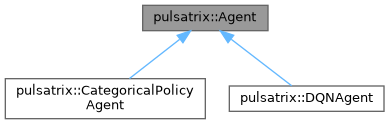
Implemented in pulsatrix::CategoricalPolicyAgent, and pulsatrix::DQNAgent.
The documentation for this class was generated from the following file:

 1.9.8
1.9.8