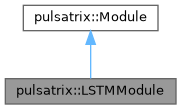
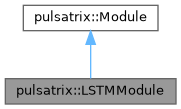
Standard 4-gate LSTM recurrence, h_0 = c_0 = 0 (zero-initialized, not learnable – the same deliberate scope cut RNNModule made, and the same thing that makes this module's conservation exact; see the LRP note below): i_t = sigmoid(x_t @ W_xi + h_{t-1} @ W_hi + b_i), f_t = sigmoid(x_t @ W_xf + h_{t-1} @ W_hf + b_f), g_t = tanh(x_t @ W_xg + h_{t-1} @ W_hg + b_g), o_t = sigmoid(x_t @ W_xo + h_{t-1} @ W_ho + b_o), c_t = f_t * c_{t-1} + i_t * g_t, h_t = o_t * tanh(c_t). Input (N, L, input_size) -> output (N, L, hidden_size), the full hidden-state sequence (matches RNNModule's convention). Single layer, no bidirectional/ multi-layer/variable-length/peephole support.
More...
|
| | LSTMModule (int64_t input_size, int64_t hidden_size, DeviceBackend *backend) |
| | Constructs an LSTM layer with zero-initialized weights/biases.
|
| |
| Tensor | backward (const Tensor &grad_output) override |
| | Real backpropagation-through-time (BPTT) across all four gates and the cell carry: accumulates every per-gate input weight, recurrent weight and bias gradient across every timestep into the same buffers via Tensor::accumulate().
|
| |
| OpType | op_type () const override |
| | Recurrent per charter's closed OpType set – a compound accumulate-over-time operation, shared with RNNModule (no enum change needed for this mission).
|
| |
| void | set_weight_xi (std::initializer_list< float > values) |
| | Overwrites the input-to-input-gate weight buffer – test/initialization use only.
|
| |
| void | set_weight_hi (std::initializer_list< float > values) |
| | Overwrites the hidden-to-input-gate weight buffer – test/initialization use only.
|
| |
| void | set_bias_i (std::initializer_list< float > values) |
| | Overwrites the input-gate bias buffer – test/initialization use only.
|
| |
| void | set_weight_xf (std::initializer_list< float > values) |
| | Overwrites the input-to-forget-gate weight buffer – test/initialization use only.
|
| |
| void | set_weight_hf (std::initializer_list< float > values) |
| | Overwrites the hidden-to-forget-gate weight buffer – test/initialization use only.
|
| |
| void | set_bias_f (std::initializer_list< float > values) |
| | Overwrites the forget-gate bias buffer – test/initialization use only.
|
| |
| void | set_weight_xg (std::initializer_list< float > values) |
| | Overwrites the input-to-cell-candidate weight buffer – test/initialization use only.
|
| |
| void | set_weight_hg (std::initializer_list< float > values) |
| | Overwrites the hidden-to-cell-candidate weight buffer – test/initialization use only.
|
| |
| void | set_bias_g (std::initializer_list< float > values) |
| | Overwrites the cell-candidate bias buffer – test/initialization use only.
|
| |
| void | set_weight_xo (std::initializer_list< float > values) |
| | Overwrites the input-to-output-gate weight buffer – test/initialization use only.
|
| |
| void | set_weight_ho (std::initializer_list< float > values) |
| | Overwrites the hidden-to-output-gate weight buffer – test/initialization use only.
|
| |
| void | set_bias_o (std::initializer_list< float > values) |
| | Overwrites the output-gate bias buffer – test/initialization use only.
|
| |
| const Tensor & | weight_xi () const |
| |
| const Tensor & | weight_hi () const |
| |
| const Tensor & | bias_i () const |
| |
| const Tensor & | weight_xf () const |
| |
| const Tensor & | weight_hf () const |
| |
| const Tensor & | bias_f () const |
| |
| const Tensor & | weight_xg () const |
| |
| const Tensor & | weight_hg () const |
| |
| const Tensor & | bias_g () const |
| |
| const Tensor & | weight_xo () const |
| |
| const Tensor & | weight_ho () const |
| |
| const Tensor & | bias_o () const |
| |
| const Tensor & | weight_xi_grad () const |
| |
| const Tensor & | weight_hi_grad () const |
| |
| const Tensor & | bias_i_grad () const |
| |
| const Tensor & | weight_xf_grad () const |
| |
| const Tensor & | weight_hf_grad () const |
| |
| const Tensor & | bias_f_grad () const |
| |
| const Tensor & | weight_xg_grad () const |
| |
| const Tensor & | weight_hg_grad () const |
| |
| const Tensor & | bias_g_grad () const |
| |
| const Tensor & | weight_xo_grad () const |
| |
| const Tensor & | weight_ho_grad () const |
| |
| const Tensor & | bias_o_grad () const |
| |
| Tensor | propagate_relevance (const Tensor &relevance_out, const LRPRuleConfig &config) override |
| | Arras et al. 2019 gate-signal LRP: gates conduct, signals receive. See the class-level note for the full per-timestep redistribution.
|
| |
| std::vector< NamedParamRef > | named_parameters () override |
| | This module's trainable parameters, each with its hierarchical name – the one place a module declares its parameters (roadmap FND-1).
|
| |
| std::optional< DeviceType > | compute_device () const override |
| | Where this layer computes, so forward() rejects an input on another device (FND-8).
|
| |
| virtual | ~Module ()=default |
| |
| Tensor | forward (const Tensor &input) |
| | Runs this module's forward computation.
|
| |
| std::pair< Tensor, NodeId > | forward_traced (const Tensor &input, NodeId input_node, ComputationGraph &graph, Autograd &autograd) |
| | Runs forward() while also registering a ComputationGraph node (tagged with this module's op_type(), parented to input_node) and wiring an Autograd backward function that reuses this module's own backward() – the opt-in traced/explainable path, per Phase 2 Mission 0.
|
| |
| virtual bool | supports_lrp_rule (LRPRule rule) const |
| | Whether propagate_relevance() implements rule (no silent fallback: callers such as ExplainerContext::relevance_pass() throw rather than run a module on a rule it does not implement).
|
| |
| virtual std::vector< ParamRef > | parameters () |
| | This module's trainable parameters and their gradients, for an optimizer to update uniformly across module types.
|
| |
| void | set_requires_grad (bool requires_grad, const std::string &prefix="") |
| | Freezes (false) or unfreezes (true) parameters by name (roadmap FND-2).
|
| |
| virtual void | set_training (bool training) |
| | Sets this module's training/eval mode. Defaults to training (matches every mainstream framework's Module default).
|
| |
| bool | is_training () const |
| | Whether this module is currently in training mode.
|
| |
Standard 4-gate LSTM recurrence, h_0 = c_0 = 0 (zero-initialized, not learnable – the same deliberate scope cut RNNModule made, and the same thing that makes this module's conservation exact; see the LRP note below): i_t = sigmoid(x_t @ W_xi + h_{t-1} @ W_hi + b_i), f_t = sigmoid(x_t @ W_xf + h_{t-1} @ W_hf + b_f), g_t = tanh(x_t @ W_xg + h_{t-1} @ W_hg + b_g), o_t = sigmoid(x_t @ W_xo + h_{t-1} @ W_ho + b_o), c_t = f_t * c_{t-1} + i_t * g_t, h_t = o_t * tanh(c_t). Input (N, L, input_size) -> output (N, L, hidden_size), the full hidden-state sequence (matches RNNModule's convention). Single layer, no bidirectional/ multi-layer/variable-length/peephole support.
- Note
- Device-generic (GPU-native-kernels Mission 5): forward(), backward() and propagate_relevance() run entirely through DeviceBackend primitives (gemm/gemm_ex, copy_2d timestep slicing, elementwise Sigmoid/Tanh, recurrent_cell(LstmForward / LstmBackward / LstmLrp), accumulate_rows, lrp_linear), reproducing the former host loops' evaluation order so CPU results are bit-identical.
-
LRP rule (Arras et al. 2019, "Explaining Recurrent Neural Network Predictions in
Sentiment Analysis"): the gates i_t, f_t, o_t are pure conductors, never relevance recipients. Every multiplicative interaction in the recurrence is an exact bilinear identity summing to its own result, so relevance splits across the signal operands only, with the gate values acting as fixed multiplicative weights:
- c_t = f_t*c_{t-1} + i_t*g_t is a two-term weighted sum (weights f_t/i_t, signals c_{t-1}/g_t); R(c_t) splits between R(c_{t-1}) and R(g_t) in proportion to f_t*c_{t-1} and i_t*g_t, via the same epsilon/z-rule redistribution RNNModule applies to its two-source pre-activation.
- h_t = o_t * tanh(c_t) is a single-signal product, so ALL of R(h_t) passes to R(tanh(c_t)) and none to R(o_t).
- tanh(c_t) -> c_t is identity pass-through (same pointwise-nonlinearity precedent as ReluModule/RNNModule, Montavon et al. 2019).
- R(g_t) is then redistributed across x_t and h_{t-1} by one epsilon/z-rule step over g_t's two weighted sources, exactly like RNNModule's. Net flow per timestep, processed in reverse time order threading both a hidden and a cell relevance accumulator (mirroring backward()'s BPTT accumulators): h_t -> c_t -> { c_{t-1} (carried to t-1), g_t -> { x_t, h_{t-1} (carried to t-1) } }. Because h_0 and c_0 are zero (this module's own scope cut), the relevance that would otherwise "leak" into the non-existent state before t=0 is provably exactly zero (both epsilon-rule numerators are proportional to c_prev/h_prev, both == 0 at t=0) – end-to-end conservation is exact up to the epsilon stabilizer, verified numerically by dedicated conservation tests.

 Public Member Functions inherited from pulsatrix::Module
 1.9.8
1.9.8