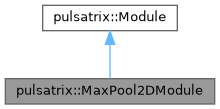
Max pooling, rank-4 (N, channels, H, W), matching Conv2DModule's convention. Stride fixed equal to kernel size (non-overlapping windows), no padding, no dilation – deferred until a real use case needs them, same minimal-cut discipline as Conv2DModule's original stride-1/no-padding scope cut.
More...
#include <max_pool2d_module.hpp>
|
| | MaxPool2DModule (int64_t kernel_h, int64_t kernel_w, DeviceBackend *backend) |
| | Constructs a max-pool layer.
|
| |
| Tensor | backward (const Tensor &grad_output) override |
| | Computes the gradient w.r.t. this module's input – only the cached argmax position within each window receives grad_output; every other position is 0.
|
| |
| OpType | op_type () const override |
| | Pooling per charter's closed OpType set.
|
| |
| Tensor | propagate_relevance (const Tensor &relevance_out, const LRPRuleConfig &config) override |
| | Winner-take-all LRP relevance propagation (Bach et al. 2015).
|
| |
| bool | supports_lrp_rule (LRPRule) const override |
| | Winner-take-all ignores the config: the same under every rule, so supports all of them.
|
| |
| std::optional< DeviceType > | compute_device () const override |
| | Where this layer computes, so forward() rejects an input on another device (FND-8).
|
| |
| virtual | ~Module ()=default |
| |
| Tensor | forward (const Tensor &input) |
| | Runs this module's forward computation.
|
| |
| std::pair< Tensor, NodeId > | forward_traced (const Tensor &input, NodeId input_node, ComputationGraph &graph, Autograd &autograd) |
| | Runs forward() while also registering a ComputationGraph node (tagged with this module's op_type(), parented to input_node) and wiring an Autograd backward function that reuses this module's own backward() – the opt-in traced/explainable path, per Phase 2 Mission 0.
|
| |
| virtual std::vector< NamedParamRef > | named_parameters () |
| | This module's trainable parameters, each with its hierarchical name – the one place a module declares its parameters (roadmap FND-1).
|
| |
| virtual std::vector< ParamRef > | parameters () |
| | This module's trainable parameters and their gradients, for an optimizer to update uniformly across module types.
|
| |
| void | set_requires_grad (bool requires_grad, const std::string &prefix="") |
| | Freezes (false) or unfreezes (true) parameters by name (roadmap FND-2).
|
| |
| virtual void | set_training (bool training) |
| | Sets this module's training/eval mode. Defaults to training (matches every mainstream framework's Module default).
|
| |
| bool | is_training () const |
| | Whether this module is currently in training mode.
|
| |
|
| Tensor | forward_impl (const Tensor &input) override |
| | The actual forward computation – per-window max, argmax cached per output element for backward()/propagate_relevance() to reuse.
|
| |
Max pooling, rank-4 (N, channels, H, W), matching Conv2DModule's convention. Stride fixed equal to kernel size (non-overlapping windows), no padding, no dilation – deferred until a real use case needs them, same minimal-cut discipline as Conv2DModule's original stride-1/no-padding scope cut.
- Note
- propagate_relevance is winner-take-all (Bach et al. 2015's supplementary treatment of max-pooling, the same rule iNNvestigate/zennit ship): all relevance at an output position flows to the single input position that was the argmax in forward(); every other position in that window gets zero. Conserves exactly by construction. backward() routes gradient the same way (only the argmax position receives grad_output; standard max-pool gradient semantics).
◆ MaxPool2DModule()
| pulsatrix::MaxPool2DModule::MaxPool2DModule |
( |
int64_t |
kernel_h, |
|
|
int64_t |
kernel_w, |
|
|
DeviceBackend * |
backend |
|
) |
| |
Constructs a max-pool layer.
- Parameters
-
| kernel_h | Window height. Also the vertical stride (non-overlapping). |
| kernel_w | Window width. Also the horizontal stride (non-overlapping). |
| backend | Backend to allocate/compute through. Not owned; must outlive this module. |
- Exceptions
-
| std::invalid_argument | if kernel_h <= 0 or kernel_w <= 0 – external boundary (construction arguments can originate from Phase 5's Python bindings with no upstream validation), per cpp_tdd/context_tdd_adversarial_boundary_testing.md. |
◆ backward()
| Tensor pulsatrix::MaxPool2DModule::backward |
( |
const Tensor & |
grad_output | ) |
|
|
overridevirtual |
Computes the gradient w.r.t. this module's input – only the cached argmax position within each window receives grad_output; every other position is 0.
- Parameters
-
| grad_output | Gradient w.r.t. this module's output. Must match the shape of the most recent forward() call's output. |
- Returns
- Gradient w.r.t. this module's input.
- Exceptions
-
| std::logic_error | if forward() has never been called. |
| std::invalid_argument | if grad_output's shape doesn't match the cached forward output shape. |
- Note
- Device-generic: runs on Cpu, Cuda or Hip tensors (GPU-native-kernels Mission 4).
Implements pulsatrix::Module.
◆ compute_device()
| std::optional< DeviceType > pulsatrix::MaxPool2DModule::compute_device |
( |
| ) |
const |
|
inlineoverridevirtual |
◆ forward_impl()
| Tensor pulsatrix::MaxPool2DModule::forward_impl |
( |
const Tensor & |
input | ) |
|
|
overrideprotectedvirtual |
The actual forward computation – per-window max, argmax cached per output element for backward()/propagate_relevance() to reuse.
- Exceptions
-
| std::invalid_argument | if input isn't rank-4 (N, C, H, W), or the kernel is larger than the input (kernel_h > H or kernel_w > W). |
- Note
- Device-generic: runs on Cpu, Cuda or Hip tensors (GPU-native-kernels Mission 4).
Implements pulsatrix::Module.
◆ op_type()
| OpType pulsatrix::MaxPool2DModule::op_type |
( |
| ) |
const |
|
inlineoverridevirtual |
◆ propagate_relevance()
Winner-take-all LRP relevance propagation (Bach et al. 2015).
- Parameters
-
| relevance_out | Relevance at this module's output. Must match the shape of the most recent forward() call's output. |
| config | Unused – winner-take-all has no tunable parameter. |
- Returns
- Relevance at this module's input: relevance_out's value at each window's cached argmax position, zero everywhere else. Conserves trivially by construction (no epsilon stabilizer needed).
- Exceptions
-
| std::logic_error | if forward() has never been called. |
| std::invalid_argument | if relevance_out's shape doesn't match the cached forward output shape. |
Implements pulsatrix::Module.
◆ supports_lrp_rule()
| bool pulsatrix::MaxPool2DModule::supports_lrp_rule |
( |
LRPRule |
| ) |
const |
|
inlineoverridevirtual |
Winner-take-all ignores the config: the same under every rule, so supports all of them.
Reimplemented from pulsatrix::Module.
The documentation for this class was generated from the following file:

 Public Member Functions inherited from pulsatrix::Module
 1.9.8
1.9.8