pulsatrix 1.1.0
Loading...
Searching...
No Matches
pulsatrix::TopKSparseAutoencoder Class Reference

A TopK sparse autoencoder: z = ReLU(TopK_k(W_enc (x - b_dec) + b_enc)), x̂ = z W_dec + b_dec. More...

#include <topk_sparse_autoencoder.hpp>

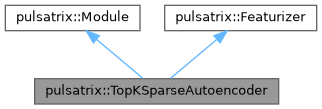
Inheritance diagram for pulsatrix::TopKSparseAutoencoder:
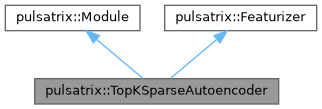
Collaboration diagram for pulsatrix::TopKSparseAutoencoder:

Public Member Functions

 TopKSparseAutoencoder (int64_t dim, int64_t num_features, DeviceBackend *backend, TopKSaeOptions options={})
 
void initialize_bias (const Tensor &x)
 Sets b_dec to the mean of x, (N, dim), as Gao et al. start it (they use the geometric median; the mean is close for activations).
 
int64_t input_dim () const override
 
int64_t num_features () const override
 
Tensor encode (const Tensor &x) override
 The codes for a batch, (N, num_features).
 
Tensor decode (const Tensor &codes) override
 The reconstruction from codes, (N, output_dim).
 
FeaturizerLoss loss_and_backward (const Tensor &x, std::vector< float > *codes=nullptr) override
 The loss and its gradients; sparsity holds the weighted auxiliary loss. Counts the batch toward dead-latent tracking.
 
void normalize_decoder () override
 Unit decoder rows (Gao et al.: the encoder isn't rescaled).
 
std::vector< float > decoder_direction (int64_t i) override
 Feature i's decoder direction, output_dim values.
 
Module & parameters_module () override
 The trainable parameters, for an optimizer's step() and zero_grad(), and for checkpoints.
 
std::vector< int64_t > dead_latents () const
 Latents dead now: none fired in the last dead_after training inputs.
 
const std::vector< int64_t > & inputs_since_fired () const
 Training inputs since each latent last fired.
 
void set_inputs_since_fired (const std::vector< int64_t > &since)
 Restores inputs_since_fired(), for example when resuming training from a checkpoint.
 
const TopKSaeOptions & options () const
 
float threshold () const
 BatchTopK's inference threshold; negative until a training batch sets it.
 
void set_threshold (float threshold)
 Sets the inference threshold (negative: select across the batch).
 
LinearModule & encoder ()
 
LinearModule & decoder ()
 
Tensor backward (const Tensor &grad_output) override
 Backward from the reconstruction's gradient, through the decoder, the selected latents, the encoder and the bias subtraction, adding to the parameters' gradients.
 
Tensor propagate_relevance (const Tensor &relevance_out, const LRPRuleConfig &config) override
 Relevance of the centered input x - b_dec: the decoder's and the encoder's own rules, passed through the selected latents.
 
OpType op_type () const override
 This module's operation-category tag, for ComputationGraph node tagging.
 
std::vector< NamedParamRef > named_parameters () override
 This module's trainable parameters, each with its hierarchical name – the one place a module declares its parameters (roadmap FND-1).
 
std::vector< NamedBufferRef > named_buffers () override
 This module's buffers: state a checkpoint must save that no optimizer updates.
 
std::optional< DeviceType > compute_device () const override
 The device this module computes on, so forward() can reject an input on another device before any kernel sees it (roadmap FND-8).
 
void set_training (bool training) override
 Sets this module's training/eval mode. Defaults to training (matches every mainstream framework's Module default).
 
void release_activations () override
 Frees the tensors forward() kept for backward() and the relevance passes; containers release their children too. Inference that only needs the output calls it after each forward, so a deep model holds one layer's activations at a time (a 1024-token ESM-2 650M pass otherwise keeps over 10 GB of them).
 
- Public Member Functions inherited from pulsatrix::Module
virtual ~Module ()=default
 
Tensor forward (const Tensor &input)
 Runs this module's forward computation.
 
std::pair< Tensor, NodeId > forward_traced (const Tensor &input, NodeId input_node, ComputationGraph &graph, Autograd &autograd)
 Runs forward() while also registering a ComputationGraph node (tagged with this module's op_type(), parented to input_node) and wiring an Autograd backward function that reuses this module's own backward() – the opt-in traced/explainable path, per Phase 2 Mission 0.
 
virtual bool supports_lrp_rule (LRPRule rule) const
 Whether propagate_relevance() implements rule (no silent fallback: callers such as ExplainerContext::relevance_pass() throw rather than run a module on a rule it does not implement).
 
virtual std::vector< NamedModuleRef > named_children ()
 This module's direct sub-modules, each under the prefix its parameters carry in named_parameters(), in the same order (TRN-7: how ApplyLora() finds a model's Linear layers). Default: none. NamedModules() walks the whole tree.
 
virtual std::vector< ParamRef > parameters ()
 This module's trainable parameters and their gradients, for an optimizer to update uniformly across module types.
 
void set_requires_grad (bool requires_grad, const std::string &prefix="")
 Freezes (false) or unfreezes (true) parameters by name (roadmap FND-2).
 
bool is_training () const
 Whether this module is currently in training mode.
 
- Public Member Functions inherited from pulsatrix::Featurizer
virtual ~Featurizer ()=default
 
virtual int64_t output_dim () const
 What decode() produces: input_dim() for an autoencoder.
 
virtual int64_t block_size () const
 Codes come in blocks of this many (FEAT-6): a block-sparse featurizer's feature is a block, active when any of its codes is nonzero, and its codes may be negative. 1 (the default) for featurizers whose features are single directions.
 
virtual Tensor predict (const Tensor &x)
 The full output for a batch, (N, output_dim): decode(encode(x)), plus any part that bypasses the codes (a transcoder's skip connection).
 
virtual FeaturizerLoss loss_and_backward_with_target (const Tensor &x, const Tensor &target, std::vector< float > *codes=nullptr)
 The loss for predicting target, (N, output_dim), from x: a transcoder's.
 

Protected Member Functions

Tensor forward_impl (const Tensor &input) override
 The reconstruction.
 

Detailed Description

A TopK sparse autoencoder: z = ReLU(TopK_k(W_enc (x - b_dec) + b_enc)), x̂ = z W_dec + b_dec.

  • No L1 penalty. k fixes how many latents fire, so codes aren't shrunk toward zero the way an L1 penalty shrinks them (SparseAutoencoder).
  • Dead latents. A latent that stops firing gets no gradient and stays dead. The auxiliary loss has the k_aux largest dead latents reconstruct the residual x - x̂; its normalized squared error |ê - e|² / |e|², weighted by aux_coefficient, gives them a gradient. The training loss is mean((x̂ - x)²) + aux_coefficient * that.
  • Decoder directions have unit norm after every normalize_decoder(). Rows are rescaled as Gao et al. do, without moving the scale into the encoder (which would change which latents are selected), and the decoder's gradient loses its component along each direction.
  • Initialization (Gao et al.): random unit decoder directions, the encoder their transpose, b_enc = 0, and b_dec = 0 until initialize_bias() sets it to the data's mean.
  • BatchTopK (batch_topk) selects across the batch in training and by threshold() at inference. Before any training batch has set the threshold, encode() selects across the batch it is given.
  • Matryoshka (matryoshka_prefixes) adds the prefixes' losses: FeaturizerLoss::total is their sum plus the auxiliary loss, and reconstruction is the full dictionary's.

It is a Module from input to reconstruction, with parameters named encoder.* and decoder.*; the decoder's bias is b_dec. BatchTopK's threshold is a buffer, threshold, so checkpoints keep it.

Constructor & Destructor Documentation

◆ TopKSparseAutoencoder()

pulsatrix::TopKSparseAutoencoder::TopKSparseAutoencoder ( int64_t  dim,
int64_t  num_features,
DeviceBackend *  backend,
TopKSaeOptions  options = {} 
)
Exceptions
std::invalid_argumentif dim or num_features < 1, k outside [1, num_features], k_aux < 0, aux_coefficient < 0, dead_after < 1, threshold_decay outside [0, 1), or prefixes that aren't increasing within [1, num_features].

Member Function Documentation

◆ backward()

Tensor pulsatrix::TopKSparseAutoencoder::backward ( const Tensor &  grad_output)
overridevirtual

Backward from the reconstruction's gradient, through the decoder, the selected latents, the encoder and the bias subtraction, adding to the parameters' gradients.

Implements pulsatrix::Module.

◆ compute_device()

std::optional< DeviceType > pulsatrix::TopKSparseAutoencoder::compute_device ( ) const
inlineoverridevirtual

The device this module computes on, so forward() can reject an input on another device before any kernel sees it (roadmap FND-8).

Returns
std::nullopt (the default) skips the check: a container whose layers check their own inputs, or a user module written before this existed. Every in-tree layer returns its device; EmbeddingModule doesn't, because it reads its indices through their own backend and so accepts them from any device.

Reimplemented from pulsatrix::Module.

◆ dead_latents()

std::vector< int64_t > pulsatrix::TopKSparseAutoencoder::dead_latents ( ) const

Latents dead now: none fired in the last dead_after training inputs.

◆ decode()

Tensor pulsatrix::TopKSparseAutoencoder::decode ( const Tensor &  codes)
overridevirtual

The reconstruction from codes, (N, output_dim).

Implements pulsatrix::Featurizer.

◆ decoder()

LinearModule & pulsatrix::TopKSparseAutoencoder::decoder ( )
inline

◆ decoder_direction()

std::vector< float > pulsatrix::TopKSparseAutoencoder::decoder_direction ( int64_t  i)
overridevirtual

Feature i's decoder direction, output_dim values.

Implements pulsatrix::Featurizer.

◆ encode()

Tensor pulsatrix::TopKSparseAutoencoder::encode ( const Tensor &  x)
overridevirtual

The codes for a batch, (N, num_features).

Implements pulsatrix::Featurizer.

◆ encoder()

LinearModule & pulsatrix::TopKSparseAutoencoder::encoder ( )
inline

◆ forward_impl()

Tensor pulsatrix::TopKSparseAutoencoder::forward_impl ( const Tensor &  input)
overrideprotectedvirtual

The reconstruction.

Exceptions
std::invalid_argumentunless the input is (N, dim), N > 0.

Implements pulsatrix::Module.

◆ initialize_bias()

void pulsatrix::TopKSparseAutoencoder::initialize_bias ( const Tensor &  x)

Sets b_dec to the mean of x, (N, dim), as Gao et al. start it (they use the geometric median; the mean is close for activations).

◆ input_dim()

int64_t pulsatrix::TopKSparseAutoencoder::input_dim ( ) const
inlineoverridevirtual

Implements pulsatrix::Featurizer.

◆ inputs_since_fired()

const std::vector< int64_t > & pulsatrix::TopKSparseAutoencoder::inputs_since_fired ( ) const
inline

Training inputs since each latent last fired.

◆ loss_and_backward()

FeaturizerLoss pulsatrix::TopKSparseAutoencoder::loss_and_backward ( const Tensor &  x,
std::vector< float > *  codes = nullptr 
)
overridevirtual

The loss and its gradients; sparsity holds the weighted auxiliary loss. Counts the batch toward dead-latent tracking.

Implements pulsatrix::Featurizer.

◆ named_buffers()

std::vector< NamedBufferRef > pulsatrix::TopKSparseAutoencoder::named_buffers ( )
overridevirtual

This module's buffers: state a checkpoint must save that no optimizer updates.

Returns
{name, tensor} entries, named like named_parameters(), in a fixed order. Default: empty. BatchNormModule reports its running statistics; containers prefix their layers' buffers the way they prefix parameters.

Reimplemented from pulsatrix::Module.

◆ named_parameters()

std::vector< NamedParamRef > pulsatrix::TopKSparseAutoencoder::named_parameters ( )
overridevirtual

This module's trainable parameters, each with its hierarchical name – the one place a module declares its parameters (roadmap FND-1).

Returns
{name, {value, grad}} entries pointing directly at this module's own members, in a fixed order. Names are unique within the module tree. Default: empty (a parameterless module like ReluModule needs no override).
Note
Override this, not parameters(): saving, loading, freezing by name and optimizer parameter groups all key on these names.

Reimplemented from pulsatrix::Module.

◆ normalize_decoder()

void pulsatrix::TopKSparseAutoencoder::normalize_decoder ( )
overridevirtual

Unit decoder rows (Gao et al.: the encoder isn't rescaled).

Implements pulsatrix::Featurizer.

◆ num_features()

int64_t pulsatrix::TopKSparseAutoencoder::num_features ( ) const
inlineoverridevirtual

Implements pulsatrix::Featurizer.

◆ op_type()

OpType pulsatrix::TopKSparseAutoencoder::op_type ( ) const
inlineoverridevirtual

This module's operation-category tag, for ComputationGraph node tagging.

Returns
This module's OpType (see op_type.hpp's closed set).
Note
Added in Phase 2 Mission 0 alongside backward() – lets graph-wiring code tag nodes generically through a Module* rather than switching on concrete subclass.

Implements pulsatrix::Module.

◆ options()

const TopKSaeOptions & pulsatrix::TopKSparseAutoencoder::options ( ) const
inline

◆ parameters_module()

Module & pulsatrix::TopKSparseAutoencoder::parameters_module ( )
inlineoverridevirtual

The trainable parameters, for an optimizer's step() and zero_grad(), and for checkpoints.

Implements pulsatrix::Featurizer.

◆ propagate_relevance()

Tensor pulsatrix::TopKSparseAutoencoder::propagate_relevance ( const Tensor &  relevance_out,
const LRPRuleConfig &  config 
)
overridevirtual

Relevance of the centered input x - b_dec: the decoder's and the encoder's own rules, passed through the selected latents.

Implements pulsatrix::Module.

◆ release_activations()

void pulsatrix::TopKSparseAutoencoder::release_activations ( )
overridevirtual

Frees the tensors forward() kept for backward() and the relevance passes; containers release their children too. Inference that only needs the output calls it after each forward, so a deep model holds one layer's activations at a time (a 1024-token ESM-2 650M pass otherwise keeps over 10 GB of them).

Note
Until the next forward(), backward() and relevance calls are invalid. The default has nothing to free.

Reimplemented from pulsatrix::Module.

◆ set_inputs_since_fired()

void pulsatrix::TopKSparseAutoencoder::set_inputs_since_fired ( const std::vector< int64_t > &  since)

Restores inputs_since_fired(), for example when resuming training from a checkpoint.

Exceptions
std::invalid_argumentunless it has num_features non-negative values.

◆ set_threshold()

void pulsatrix::TopKSparseAutoencoder::set_threshold ( float  threshold)

Sets the inference threshold (negative: select across the batch).

◆ set_training()

void pulsatrix::TopKSparseAutoencoder::set_training ( bool  training)
overridevirtual

Sets this module's training/eval mode. Defaults to training (matches every mainstream framework's Module default).

Note
Virtual since Phase 6 Mission 6 (SequentialModule) – Mission 5 originally shipped this as plain non-virtual state ("no composite container exists yet to cascade through"); SequentialModule overrides this to cascade to every contained layer, and needs virtual dispatch to do so correctly even when accessed through a Module* base pointer, not just its own concrete type.
BatchNormModule keeps running statistics in training mode and normalizes with them in eval mode; DropoutModule is the identity in eval mode. Call set_training(false) before explaining a model that has either, so a sample's explanation doesn't depend on the rest of its batch.

Reimplemented from pulsatrix::Module.

◆ threshold()

float pulsatrix::TopKSparseAutoencoder::threshold ( ) const

BatchTopK's inference threshold; negative until a training batch sets it.


The documentation for this class was generated from the following file: