 |
pulsatrix 1.1.0
|
|
pulsatrix 1.1.0
|
Concept Relevance Propagation (INT-6): which of a layer's channels an LRP explanation passes through, where each one looks in the input, and which inputs show it at work. More...
#include <cstdint>#include <vector>#include "pulsatrix/attribution.hpp"#include "pulsatrix/explainer_context.hpp"#include "pulsatrix/lrp.hpp"#include "pulsatrix/tensor.hpp"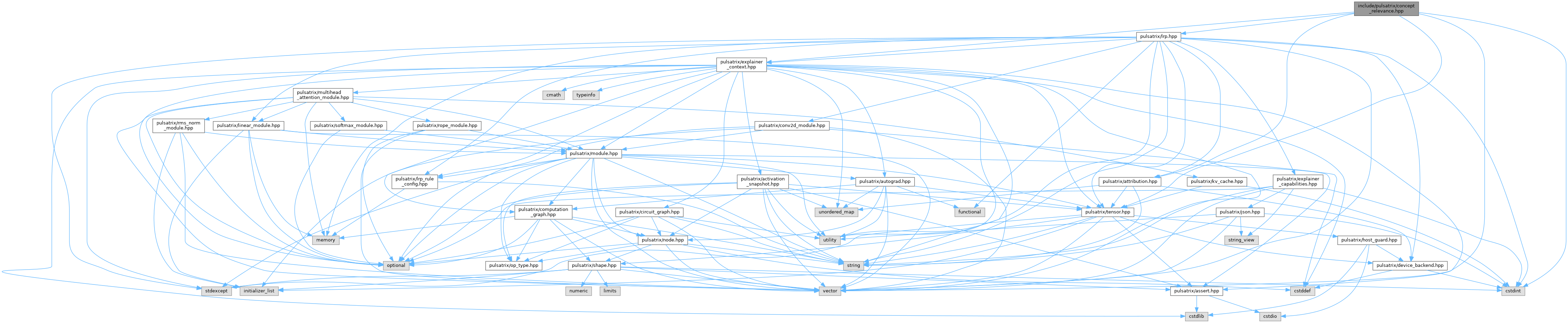
Go to the source code of this file.
Classes | |
| struct | pulsatrix::ConceptMask |
| Keep the relevance of these channels at this layer, and zero the rest. More... | |
Namespaces | |
| namespace | pulsatrix |
Typedefs | |
| using | pulsatrix::ConceptCondition = std::vector< ConceptMask > |
| One conditional heatmap's masks, at most one per layer. | |
Enumerations | |
| enum class | pulsatrix::ReferenceMode { pulsatrix::Relevance , pulsatrix::Activation } |
| How ConceptReferenceSamples() ranks inputs. More... | |
Functions | |
| Tensor | pulsatrix::LayerRelevance (const LRP &lrp, ExplainerContext &ctx, const Tensor &input, const LRPTarget &target, NodeId layer, DeviceBackend *backend) |
The relevance at layer for explaining target: the layer's shape, (N, C, ...). | |
| std::vector< double > | pulsatrix::ChannelRelevance (const Tensor &layer_relevance) |
| Each row's relevance per channel, summed over the remaining dimensions: (N, C) values, row-major. With a conserving rule they add up to the explained output. | |
| std::vector< Attribution > | pulsatrix::ConditionalHeatmaps (const LRP &lrp, ExplainerContext &ctx, const Tensor &input, const LRPTarget &target, const std::vector< ConceptCondition > &conditions, DeviceBackend *backend) |
One input heatmap per condition: LRP from target with the relevance zeroed, at each masked layer, outside the mask's channels. | |
| std::vector< int64_t > | pulsatrix::ConceptReferenceSamples (const LRP &lrp, ExplainerContext &ctx, const Tensor &candidates, int64_t target, NodeId layer, int64_t channel, int64_t k, ReferenceMode mode, DeviceBackend *backend) |
The k inputs of candidates that show a channel best, best first: the reference samples by which CRP shows what a concept is. | |
Concept Relevance Propagation (INT-6): which of a layer's channels an LRP explanation passes through, where each one looks in the input, and which inputs show it at work.
An LRP heatmap says where in the input the evidence for a class is, but not what it is. CRP (Achtibat et al., Nature Machine Intelligence 2023) takes the relevance at a hidden layer, where each channel (a convolution's filter, a dense layer's unit) stands for a learned concept, and asks three questions:
LRP's rules are linear in the relevance they pass down, so the conditional heatmaps of every channel of a layer add up to the plain LRP heatmap. Everything uses the same LRP object, so the rules are the ones LRP::explain() would apply.
 1.9.8