 |
pulsatrix 1.1.0
|
|
pulsatrix 1.1.0
|
Pairwise Euclidean distances of a point cloud, computed with one GEMM on any backend, with a certified bound on their floating-point error. More...
#include <cstddef>#include <cstdint>#include <vector>#include "pulsatrix/tda/point_cloud.hpp"#include "pulsatrix/tensor.hpp"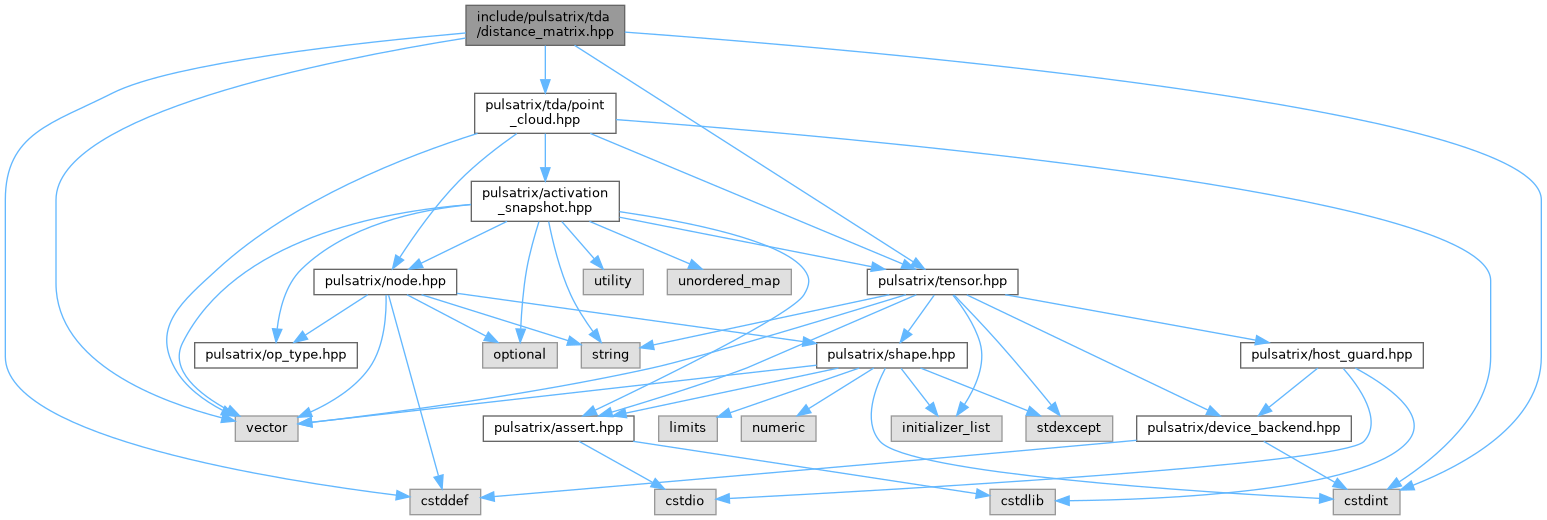
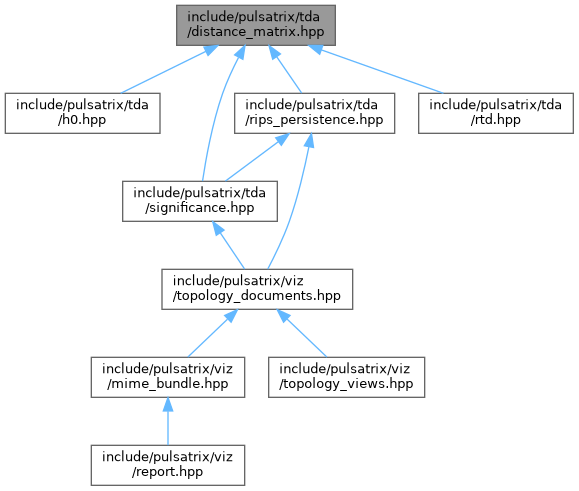
Go to the source code of this file.
Classes | |
| struct | pulsatrix::DistanceOptions |
| PairwiseDistances()'s settings. More... | |
| struct | pulsatrix::DistanceMatrix |
| The distances between every pair of n points, condensed. More... | |
Namespaces | |
| namespace | pulsatrix |
Enumerations | |
| enum class | pulsatrix::DistanceMethod { pulsatrix::Gemm , pulsatrix::Exact } |
| How PairwiseDistances() computes the distances. More... | |
Functions | |
| DistanceMatrix | pulsatrix::PairwiseDistances (const Tensor &points, const DistanceOptions &options={}) |
| Euclidean distances between every pair of rows. | |
| DistanceMatrix | pulsatrix::PairwiseDistances (const PointCloud &cloud, DeviceBackend *backend, const DistanceOptions &options={}) |
| Euclidean distances between every pair of a cloud's points, on the given backend. | |
Pairwise Euclidean distances of a point cloud, computed with one GEMM on any backend, with a certified bound on their floating-point error.
Distances are the only stage of persistent homology that touches the points' dimension, so they run as a matrix product on the device: |x - y|^2 = |x|^2 + |y|^2 - 2 x.y. In float32 that formula cancels badly for points close together (the research notes' warning for TDA-2), so the result carries an error bound instead of hiding it. Stability (Cohen-Steiner, Edelsbrunner and Harer, 2007) turns the bound into one on everything computed later: a persistence diagram built from these distances is within error_bound, in bottleneck distance, of the exact one.
 1.9.8