 |
pulsatrix 1.1.0
|
|
pulsatrix 1.1.0
|
How much an explanation changes when its input barely does (KS-4): the max- and average-sensitivity of Yeh et al. (NeurIPS 2019), the local Lipschitz estimate of Alvarez-Melis and Jaakkola (2018), and the sensitivity at the perturbation an attacker would try first, FGSM's. More...
#include <cstdint>#include <optional>#include <string>#include "pulsatrix/adversarial.hpp"#include "pulsatrix/explanation_metrics.hpp"#include "pulsatrix/json.hpp"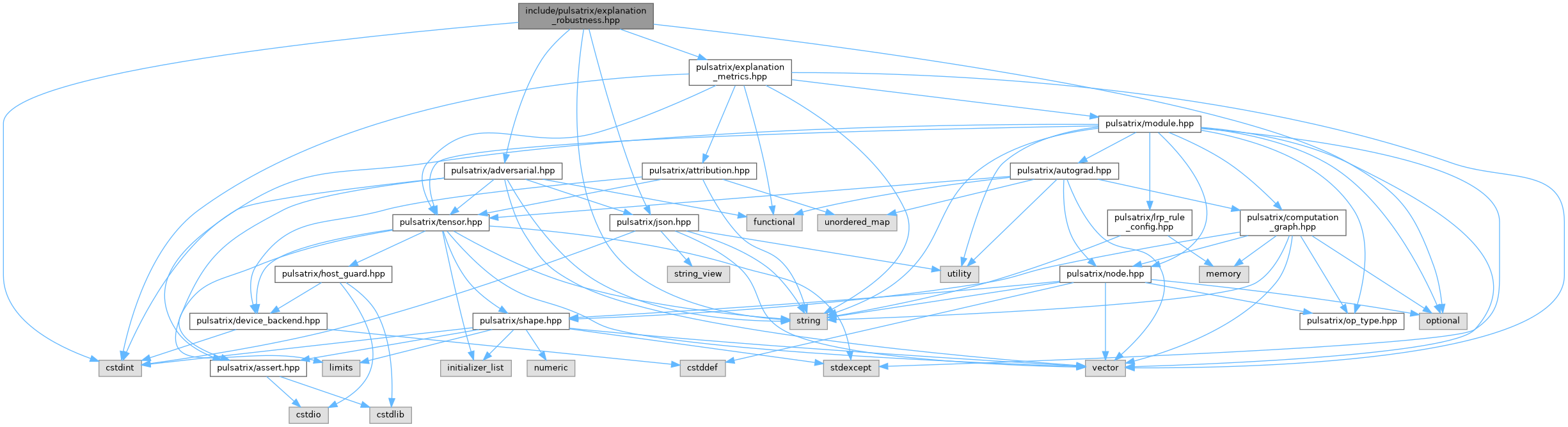
Go to the source code of this file.
Classes | |
| struct | pulsatrix::SensitivityOptions |
| ExplanationSensitivity()'s settings. More... | |
| struct | pulsatrix::SensitivityReport |
| ExplanationSensitivity()'s result. More... | |
Namespaces | |
| namespace | pulsatrix |
Functions | |
| SensitivityReport | pulsatrix::ExplanationSensitivity (const Tensor &input, const ExplainFn &explain, const PredictFn &predict, const DifferentiableClassifier *classifier, DeviceBackend *backend, const SensitivityOptions &options={}) |
Measures how much explain's explanation of input changes under small perturbations. | |
| JsonValue | pulsatrix::ToJson (const SensitivityReport &report) |
The report as a pulsatrix.explanation_sensitivity.v1 document. | |
How much an explanation changes when its input barely does (KS-4): the max- and average-sensitivity of Yeh et al. (NeurIPS 2019), the local Lipschitz estimate of Alvarez-Melis and Jaakkola (2018), and the sensitivity at the perturbation an attacker would try first, FGSM's.
An explanation that changes a lot under a change to the input too small to change the prediction says more about the explainer than the model: Ghorbani, Abid and Zou (AAAI 2019) changed saliency maps beyond recognition with imperceptible perturbations. These are the robustness metrics of Quantus (Hedström et al., JMLR 2023), computed the same way:
The samples are uniform in the L∞ ball of radius radius times the input's standard deviation, and only those that keep the predicted class count: an explanation should change when the prediction does. tests/explanation_robustness_test.cpp checks the metrics against tools/generate_explanation_robustness_reference_values.py, which draws the same samples.
 1.9.8