 |
pulsatrix 1.1.0
|
|
pulsatrix 1.1.0
|
How good a featurizer is (FEAT-3), after SAEBench (Karvonen et al., arXiv 2503.09532): reconstruction (explained variance, cosine, norm ratio, L0, dead and dense latents), loss recovered when the reconstruction is spliced back into the model, and feature absorption (Chanin et al., arXiv 2409.14507) with a linear probe as its baseline. More...
#include <cstdint>#include <functional>#include <utility>#include <vector>#include "pulsatrix/causal_lm.hpp"#include "pulsatrix/featurizer.hpp"#include "pulsatrix/mlp_hook.hpp"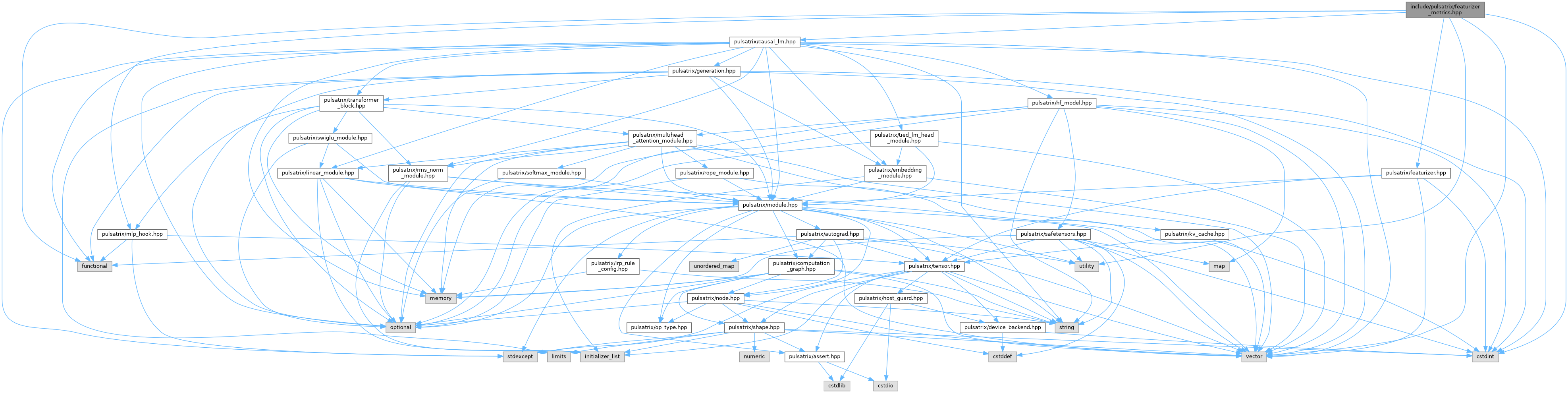
Go to the source code of this file.
Classes | |
| struct | pulsatrix::ReconstructionMetrics |
| EvaluateReconstruction()'s result. More... | |
| struct | pulsatrix::LossRecovered |
| MeasureLossRecovered()'s result: the model's loss three ways. More... | |
| struct | pulsatrix::AbsorptionOptions |
| struct | pulsatrix::AbsorptionResult |
| FeatureAbsorption()'s result, on the held-out inputs. More... | |
Namespaces | |
| namespace | pulsatrix |
Functions | |
| ReconstructionMetrics | pulsatrix::EvaluateReconstruction (Featurizer &featurizer, const Tensor &x, double dense_rate=0.1, int64_t batch=4096) |
Encodes and reconstructs x, (N, input_dim), in batches of batch rows. | |
| ReconstructionMetrics | pulsatrix::EvaluatePrediction (Featurizer &featurizer, const Tensor &x, const Tensor &target, double dense_rate=0.1, int64_t batch=4096) |
EvaluateReconstruction for a transcoder: predict(x) against target, (N, output_dim). Explained variance is relative to the targets' variance. | |
| HiddenStateHook | pulsatrix::SpliceHook (Featurizer &featurizer, int64_t position, std::vector< bool > rows={}) |
Splices the featurizer in at one position: a hook that replaces the hidden states there, (N, L, input_dim), by their reconstructions, and leaves other positions alone. | |
| HiddenStateHook | pulsatrix::AblationHook (int64_t position, std::vector< bool > rows={}) |
| Zero-ablates one position: the same rows set to 0 instead of reconstructed. | |
| MlpHook | pulsatrix::MlpSpliceHook (Featurizer &transcoder, std::vector< bool > rows={}) |
| Splices a transcoder in for an MLP (install it with EncoderBlock::set_mlp_hook() or TransformerBlock::set_mlp_hook()): the MLP's output rows are replaced by predict() of its input rows. | |
| MlpHook | pulsatrix::MlpAblationHook (std::vector< bool > rows={}) |
| Zero-ablates an MLP: its output rows set to 0. | |
| LossRecovered | pulsatrix::MeasureLossRecovered (Featurizer &featurizer, int64_t position, const std::function< double(const HiddenStateHook &)> &loss, const std::vector< bool > &rows={}) |
| Loss recovered, SAEBench's main downstream measure. | |
| LossRecovered | pulsatrix::MeasureMlpLossRecovered (Featurizer &transcoder, const std::function< double(const MlpHook &)> &loss, const std::vector< bool > &rows={}) |
Loss recovered for a transcoder spliced in for an MLP: loss installs the MlpHook it is given on the MLP's block, runs the model, removes it and returns the loss. Ablation zeroes the MLP's output. | |
| AbsorptionResult | pulsatrix::FeatureAbsorption (Featurizer &featurizer, const Tensor &x, const std::vector< int > &labels, const AbsorptionOptions &options={}) |
| Feature absorption (Chanin et al.; SAEBench's version, in outline). A concept is absorbed when the features that stand for it stay silent on an input that has it, because a more specific feature fires instead and carries its direction: a "starts
with S" feature that skips "short", which a "short" feature covers. | |
How good a featurizer is (FEAT-3), after SAEBench (Karvonen et al., arXiv 2503.09532): reconstruction (explained variance, cosine, norm ratio, L0, dead and dense latents), loss recovered when the reconstruction is spliced back into the model, and feature absorption (Chanin et al., arXiv 2409.14507) with a linear probe as its baseline.
 1.9.8