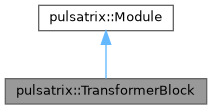
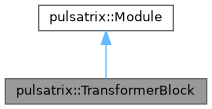
y1 = x + MHA(RMSNorm(x)), y2 = y1 + SwiGLU(RMSNorm(y1)). Shape (N, L, d_model) -> (N, L, d_model).
More...
#include <transformer_block.hpp>
|
| | TransformerBlock (int64_t d_model, int64_t num_heads, int64_t d_ff, DeviceBackend *backend, bool use_rope=true, bool use_qk_norm=false) |
| | Constructs a transformer block with zero-initialized sub-module parameters.
|
| |
| Tensor | backward (const Tensor &grad_output) override |
| | Gradient w.r.t. this module's input; sub-module parameter gradients accumulate inside norm1_/mha_/norm2_/swiglu_ (reachable through parameters()).
|
| |
| OpType | op_type () const override |
| | Elementwise per this module's own op_type() note above.
|
| |
| Tensor | propagate_relevance (const Tensor &relevance_out, const LRPRuleConfig &config) override |
| | LRP relevance propagation: two residual epsilon/z-rule splits composed with norm1_'s/mha_'s/norm2_'s/swiglu_'s own propagate_relevance().
|
| |
| std::vector< NamedParamRef > | named_parameters () override |
| | norm1_'s, mha_'s, norm2_'s, and swiglu_'s parameters, flattened.
|
| |
| void | set_training (bool training) override |
| | Cascades to every sub-module, the same way SequentialModule/MultiHeadAttentionModule do.
|
| |
| int64_t | d_model () const |
| |
| std::optional< DeviceType > | compute_device () const override |
| | Where this layer computes, so forward() rejects an input on another device (FND-8).
|
| |
|
| RMSNormModule & | norm1 () |
| |
| MultiHeadAttentionModule & | mha () |
| |
| RMSNormModule & | norm2 () |
| |
| SwiGLUModule & | swiglu () |
| |
| virtual | ~Module ()=default |
| |
| Tensor | forward (const Tensor &input) |
| | Runs this module's forward computation.
|
| |
| std::pair< Tensor, NodeId > | forward_traced (const Tensor &input, NodeId input_node, ComputationGraph &graph, Autograd &autograd) |
| | Runs forward() while also registering a ComputationGraph node (tagged with this module's op_type(), parented to input_node) and wiring an Autograd backward function that reuses this module's own backward() – the opt-in traced/explainable path, per Phase 2 Mission 0.
|
| |
| virtual bool | supports_lrp_rule (LRPRule rule) const |
| | Whether propagate_relevance() implements rule (no silent fallback: callers such as ExplainerContext::relevance_pass() throw rather than run a module on a rule it does not implement).
|
| |
| virtual std::vector< ParamRef > | parameters () |
| | This module's trainable parameters and their gradients, for an optimizer to update uniformly across module types.
|
| |
| void | set_requires_grad (bool requires_grad, const std::string &prefix="") |
| | Freezes (false) or unfreezes (true) parameters by name (roadmap FND-2).
|
| |
| bool | is_training () const |
| | Whether this module is currently in training mode.
|
| |
|
| Tensor | forward_impl (const Tensor &input) override |
| | Runs: norm1 -> attention -> residual add -> norm2 -> SwiGLU -> residual add.
|
| |
y1 = x + MHA(RMSNorm(x)), y2 = y1 + SwiGLU(RMSNorm(y1)). Shape (N, L, d_model) -> (N, L, d_model).
Composition over inheritance, third exercise of this principle after MultiHeadAttentionModule and SwiGLUModule: norm1_/norm2_/mha_/swiglu_ are real sub-objects driven through their own forward()/backward()/propagate_relevance(). The only hand-written operation is the residual add, using this codebase's own two-term weighted-sum epsilon/z-rule (the same shape LSTMModule's c_t = f_t*c_{t-1}+i_t*g_t and GRUModule's h_t = (1-z_t)*h_{t-1}+z_t*n_t already use, weight fixed at 1 instead of a gate value) – AttnLRP does not itself address residual connections; this is mission_transformer_block.md's own resolution, not a new rule invented ad hoc.
- Note
- **
RMSNormModule, not LayerNormModule**, for stylistic consistency with this block's other LLaMA-family choices (SwiGLU, RoPE, optional QK-Norm) – not a technical requirement; both are AttnLRP Eq. 19 identity-pass-through and would work identically here.
-
op_type() reuses OpType::Elementwise – the residual add is a plain elementwise binary op with fixed weight 1, the same category RoPEModule and SwiGLUModule's gate multiply already reuse. Not Composite (this module owns real math, the residual split, disqualifying it by MultiHeadAttentionModule's own precedent) and not a new category (unlike attention's genuinely novel cross-position mixing, a residual add is not architecturally novel).
-
Conservation is dominated by
MultiHeadAttentionModule's own known large gap (measured ~49.6% of its own output in mission_multihead_attention.md), propagated through unchanged by the two residual splits (which conserve near-exactly, same argument as SwiGLUModule's diagonal split) and by SwiGLUModule's own near-exact contribution. Measured and decomposed stage-by-stage in tests/transformer_block_test.cpp, not assumed.
- See also
- cpp_engineering.aDNA's what/context/cpp_tdd/context_tdd_lrp_rule_pattern_taxonomy.md, "Known-Non-Conserving-by-Design Note" – this block's gap is inherited from MultiHeadAttentionModule, not a new instance of the exception.
◆ TransformerBlock()
| pulsatrix::TransformerBlock::TransformerBlock |
( |
int64_t |
d_model, |
|
|
int64_t |
num_heads, |
|
|
int64_t |
d_ff, |
|
|
DeviceBackend * |
backend, |
|
|
bool |
use_rope = true, |
|
|
bool |
use_qk_norm = false |
|
) |
| |
Constructs a transformer block with zero-initialized sub-module parameters.
- Parameters
-
- Exceptions
-
| std::invalid_argument | propagated from MultiHeadAttentionModule's or SwiGLUModule's own constructors (d_model <= 0, num_heads <= 0, d_model % num_heads != 0, d_ff <= 0, odd head_dim with use_rope) – no redundant re-validation here. |
◆ backward()
| Tensor pulsatrix::TransformerBlock::backward |
( |
const Tensor & |
grad_output | ) |
|
|
overridevirtual |
Gradient w.r.t. this module's input; sub-module parameter gradients accumulate inside norm1_/mha_/norm2_/swiglu_ (reachable through parameters()).
- Parameters
-
| grad_output | Gradient w.r.t. this module's output, shape (N, L, d_model) matching the cached forward shape. |
- Returns
- Gradient w.r.t. this module's input, same shape.
- Exceptions
-
| std::logic_error | if called before any forward(). |
| std::invalid_argument | if grad_output's shape differs from the cached forward shape. |
- Note
- Device-generic: runs on Cpu, Cuda or Hip tensors (GPU-native-kernels Mission 2).
Implements pulsatrix::Module.
◆ compute_device()
| std::optional< DeviceType > pulsatrix::TransformerBlock::compute_device |
( |
| ) |
const |
|
inlineoverridevirtual |
◆ d_model()
| int64_t pulsatrix::TransformerBlock::d_model |
( |
| ) |
const |
|
inline |
◆ forward_impl()
| Tensor pulsatrix::TransformerBlock::forward_impl |
( |
const Tensor & |
input | ) |
|
|
overrideprotectedvirtual |
Runs: norm1 -> attention -> residual add -> norm2 -> SwiGLU -> residual add.
- Parameters
-
| input | (N, L, d_model), any device. |
- Returns
(N, L, d_model).
- Exceptions
-
| std::invalid_argument | if input's rank < 2 or final dimension != d_model. |
Implements pulsatrix::Module.
◆ mha()
◆ named_parameters()
| std::vector< NamedParamRef > pulsatrix::TransformerBlock::named_parameters |
( |
| ) |
|
|
overridevirtual |
norm1_'s, mha_'s, norm2_'s, and swiglu_'s parameters, flattened.
Reimplemented from pulsatrix::Module.
◆ norm1()
◆ norm2()
◆ op_type()
| OpType pulsatrix::TransformerBlock::op_type |
( |
| ) |
const |
|
inlineoverridevirtual |
◆ propagate_relevance()
LRP relevance propagation: two residual epsilon/z-rule splits composed with norm1_'s/mha_'s/norm2_'s/swiglu_'s own propagate_relevance().
- Parameters
-
| relevance_out | Relevance at this module's output, matching the cached forward shape. |
| config | Supplies the epsilon stabilizer for the residual splits and every composed sub-module rule. |
- Returns
- Relevance at this module's input, same shape as relevance_out.
- Exceptions
-
| std::logic_error | if called before any forward(). |
| std::invalid_argument | if relevance_out's shape differs from the cached forward shape. |
- Note
- Device-generic: runs on Cpu, Cuda or Hip tensors (GPU-native-kernels Mission 3).
Implements pulsatrix::Module.
◆ set_training()
| void pulsatrix::TransformerBlock::set_training |
( |
bool |
training | ) |
|
|
overridevirtual |
Cascades to every sub-module, the same way SequentialModule/MultiHeadAttentionModule do.
Reimplemented from pulsatrix::Module.
◆ swiglu()
The documentation for this class was generated from the following file:

 Public Member Functions inherited from pulsatrix::Module
 1.9.8
1.9.8