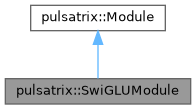
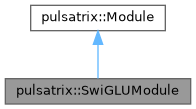
down_proj(silu(gate_proj(x)) * up_proj(x)), the gated feedforward block used in place of a plain two-linear-layer MLP in most modern transformers. Rank-agnostic over (..., d_model) -> (..., d_model), matching MultiHeadAttentionModule's I/O contract so Phase 3 Mission 5 (TransformerBlock) can chain them directly.
More...
#include <swiglu_module.hpp>
|
| | SwiGLUModule (int64_t d_model, int64_t d_ff, DeviceBackend *backend) |
| | Constructs a SwiGLU block with zero-initialized projections.
|
| |
| Tensor | backward (const Tensor &grad_output) override |
| | Gradient w.r.t. this module's input; sub-module parameter gradients accumulate inside gate_proj_/up_proj_/down_proj_ (reachable through parameters()).
|
| |
| OpType | op_type () const override |
| | Elementwise per this module's own op_type() note above.
|
| |
| Tensor | propagate_relevance (const Tensor &relevance_out, const LRPRuleConfig &config) override |
| | LRP relevance propagation: down_proj_'s epsilon rule, then the diagonal Eq. 15 split into gate/up shares, then SiLU's identity pass-through, then gate_proj_'s/up_proj_'s epsilon rules summed.
|
| |
| std::vector< NamedParamRef > | named_parameters () override |
| | gate_proj_'s, up_proj_'s, and down_proj_'s parameters, flattened.
|
| |
| int64_t | d_model () const |
| |
| int64_t | d_ff () const |
| |
| std::optional< DeviceType > | compute_device () const override |
| | Where this layer computes, so forward() rejects an input on another device (FND-8).
|
| |
|
| LinearModule & | gate_proj () |
| |
| LinearModule & | up_proj () |
| |
| LinearModule & | down_proj () |
| |
| virtual | ~Module ()=default |
| |
| Tensor | forward (const Tensor &input) |
| | Runs this module's forward computation.
|
| |
| std::pair< Tensor, NodeId > | forward_traced (const Tensor &input, NodeId input_node, ComputationGraph &graph, Autograd &autograd) |
| | Runs forward() while also registering a ComputationGraph node (tagged with this module's op_type(), parented to input_node) and wiring an Autograd backward function that reuses this module's own backward() – the opt-in traced/explainable path, per Phase 2 Mission 0.
|
| |
| virtual bool | supports_lrp_rule (LRPRule rule) const |
| | Whether propagate_relevance() implements rule (no silent fallback: callers such as ExplainerContext::relevance_pass() throw rather than run a module on a rule it does not implement).
|
| |
| virtual std::vector< ParamRef > | parameters () |
| | This module's trainable parameters and their gradients, for an optimizer to update uniformly across module types.
|
| |
| void | set_requires_grad (bool requires_grad, const std::string &prefix="") |
| | Freezes (false) or unfreezes (true) parameters by name (roadmap FND-2).
|
| |
| virtual void | set_training (bool training) |
| | Sets this module's training/eval mode. Defaults to training (matches every mainstream framework's Module default).
|
| |
| bool | is_training () const |
| | Whether this module is currently in training mode.
|
| |
down_proj(silu(gate_proj(x)) * up_proj(x)), the gated feedforward block used in place of a plain two-linear-layer MLP in most modern transformers. Rank-agnostic over (..., d_model) -> (..., d_model), matching MultiHeadAttentionModule's I/O contract so Phase 3 Mission 5 (TransformerBlock) can chain them directly.
Composition over inheritance, same principle MultiHeadAttentionModule established: gate_proj_/up_proj_/down_proj_ are real LinearModule sub-objects driven through their own forward()/backward()/propagate_relevance(). The only hand-written operation is the elementwise silu(gate) * up gate – its LRP rule is a diagonal specialization of AttnLRP's Eq. 15 (Achtibat et al. 2024): for c[i] = a[i]*b[i], the sum_k over a matmul's shared contraction index collapses to a single term since there is no contraction, giving R_a[i] += (a[i]*b[i]/(2*c[i]+eps*sign(c[i]))) * R_c[i], symmetrically for R_b[i] – the same rule MultiHeadAttentionModule uses for its two batched matmuls, specialized to a diagonal case instead of a real contraction.
- Note
- SiLU itself gets this codebase's existing pointwise-nonlinearity identity pass-through treatment (Montavon et al. 2019 – the same convention already applied to
ReluModule/DropoutModule/RMSNorm's-and-LayerNorm's Eq. 19 identity rule), extended here to a smooth, non-piecewise-linear nonlinearity for the first time in this codebase. A known approximation (not an exact DTD derivation for SiLU specifically), consistent with this codebase's own established simplification for every other pointwise nonlinearity so far – see mission_swiglu.md's Recon.
-
Conserves near-exactly (unlike
SoftmaxModule's/MultiHeadAttentionModule's large by-design gap): the diagonal split above satisfies R_a[i]+R_b[i] = 2*(c[i]/(2c[i]+eps))*R_c[i] ~= R_c[i] (exact at eps=0), and SiLU's pass-through is exact by construction – so the whole composed module should conserve up to an epsilon residual only, same category as RoPEModule. Measured and confirmed in tests/swiglu_module_test.cpp, not just asserted.
-
op_type() reuses OpType::Elementwise – same resolution RoPEModule made (the hand-written novel part is an elementwise gate multiply, not a new operation category). Contrast MultiHeadAttentionModule, which earned a new category for genuinely novel cross-position mixing this module does not do – every position here is processed independently.
◆ SwiGLUModule()
| pulsatrix::SwiGLUModule::SwiGLUModule |
( |
int64_t |
d_model, |
|
|
int64_t |
d_ff, |
|
|
DeviceBackend * |
backend |
|
) |
| |
Constructs a SwiGLU block with zero-initialized projections.
- Parameters
-
| d_model | Input/output width. |
| d_ff | Hidden (gate/up) width. |
| backend | Backend to allocate/compute through. Not owned; must outlive this module. |
- Exceptions
-
| std::invalid_argument | if d_model <= 0 or d_ff <= 0 – external boundary (construction arguments can originate from Phase 5's Python bindings with no upstream validation), same convention as every other constructor. |
◆ backward()
| Tensor pulsatrix::SwiGLUModule::backward |
( |
const Tensor & |
grad_output | ) |
|
|
overridevirtual |
Gradient w.r.t. this module's input; sub-module parameter gradients accumulate inside gate_proj_/up_proj_/down_proj_ (reachable through parameters()).
- Parameters
-
| grad_output | Gradient w.r.t. this module's output, matching the cached forward shape. |
- Returns
- Gradient w.r.t. this module's input, same shape as grad_output.
- Exceptions
-
| std::logic_error | if called before any forward(). |
| std::invalid_argument | if grad_output's shape differs from the cached forward shape. |
- Note
- Device-generic: the gate derivative is DeviceBackend::elementwise_backward(Silu), the products DeviceBackend::mul (GPU-native-kernels Mission 1).
Implements pulsatrix::Module.
◆ compute_device()
| std::optional< DeviceType > pulsatrix::SwiGLUModule::compute_device |
( |
| ) |
const |
|
inlineoverridevirtual |
◆ d_ff()
| int64_t pulsatrix::SwiGLUModule::d_ff |
( |
| ) |
const |
|
inline |
◆ d_model()
| int64_t pulsatrix::SwiGLUModule::d_model |
( |
| ) |
const |
|
inline |
◆ down_proj()
◆ forward_impl()
| Tensor pulsatrix::SwiGLUModule::forward_impl |
( |
const Tensor & |
input | ) |
|
|
overrideprotectedvirtual |
Runs: project (gate, up) -> silu(gate) -> gate*up -> project (down).
- Parameters
-
| input | (..., d_model), rank >= 2, any device. |
- Returns
(..., d_model), same shape as input.
- Exceptions
-
| std::invalid_argument | if input's rank < 2 or final dimension != d_model. |
Implements pulsatrix::Module.
◆ gate_proj()
◆ named_parameters()
| std::vector< NamedParamRef > pulsatrix::SwiGLUModule::named_parameters |
( |
| ) |
|
|
overridevirtual |
gate_proj_'s, up_proj_'s, and down_proj_'s parameters, flattened.
Reimplemented from pulsatrix::Module.
◆ op_type()
| OpType pulsatrix::SwiGLUModule::op_type |
( |
| ) |
const |
|
inlineoverridevirtual |
◆ propagate_relevance()
LRP relevance propagation: down_proj_'s epsilon rule, then the diagonal Eq. 15 split into gate/up shares, then SiLU's identity pass-through, then gate_proj_'s/up_proj_'s epsilon rules summed.
- Parameters
-
| relevance_out | Relevance at this module's output, matching the cached forward shape. |
| config | Supplies the epsilon stabilizer for both the diagonal split and the three LinearModule epsilon rules. |
- Returns
- Relevance at this module's input, same shape as relevance_out.
- Exceptions
-
| std::logic_error | if called before any forward(). |
| std::invalid_argument | if relevance_out's shape differs from the cached forward shape. |
- Note
- Device-generic: runs on Cpu, Cuda or Hip tensors (GPU-native-kernels Mission 3).
Implements pulsatrix::Module.
◆ up_proj()
The documentation for this class was generated from the following file:

 Public Member Functions inherited from pulsatrix::Module
 1.9.8
1.9.8