y = x + inner->forward(x) for an arbitrary already-built Module. The classic ResNet shortcut connection, owning its own native relevance-split rule – the charter's explicitly named failure mode to avoid is Captum/Zennit's "Canonizer
surgery" (an external post-hoc graph rewrite for residual connections).
More...
#include <residual_module.hpp>
|
| | ResidualModule (Module *inner, DeviceBackend *backend) |
| | Constructs a residual wrapper around an existing Module.
|
| |
| Tensor | backward (const Tensor &grad_output) override |
| | Gradient w.r.t. this module's input: both paths receive grad_output unchanged (real gradient of a plain sum), then inner_'s own backward() adds its contribution.
|
| |
| OpType | op_type () const override |
| | Elementwise per this module's own op_type() note above.
|
| |
| Tensor | propagate_relevance (const Tensor &relevance_out, const LRPRuleConfig &config) override |
| | LRP relevance propagation: the residual epsilon/z-rule split between x and inner_->forward(x), then inner_'s own propagate_relevance() for its share.
|
| |
| std::vector< NamedParamRef > | named_parameters () override |
| | inner_'s own named_parameters(), prefixed inner. – this module owns none of its own.
|
| |
| void | set_training (bool training) override |
| | Cascades to inner_, the same way SequentialModule/MultiHeadAttentionModule do.
|
| |
| Module & | inner () |
| |
| std::optional< DeviceType > | compute_device () const override |
| | Where this layer computes, so forward() rejects an input on another device (FND-8).
|
| |
| virtual | ~Module ()=default |
| |
| Tensor | forward (const Tensor &input) |
| | Runs this module's forward computation.
|
| |
| std::pair< Tensor, NodeId > | forward_traced (const Tensor &input, NodeId input_node, ComputationGraph &graph, Autograd &autograd) |
| | Runs forward() while also registering a ComputationGraph node (tagged with this module's op_type(), parented to input_node) and wiring an Autograd backward function that reuses this module's own backward() – the opt-in traced/explainable path, per Phase 2 Mission 0.
|
| |
| virtual bool | supports_lrp_rule (LRPRule rule) const |
| | Whether propagate_relevance() implements rule (no silent fallback: callers such as ExplainerContext::relevance_pass() throw rather than run a module on a rule it does not implement).
|
| |
| virtual std::vector< ParamRef > | parameters () |
| | This module's trainable parameters and their gradients, for an optimizer to update uniformly across module types.
|
| |
| void | set_requires_grad (bool requires_grad, const std::string &prefix="") |
| | Freezes (false) or unfreezes (true) parameters by name (roadmap FND-2).
|
| |
| bool | is_training () const |
| | Whether this module is currently in training mode.
|
| |
y = x + inner->forward(x) for an arbitrary already-built Module. The classic ResNet shortcut connection, owning its own native relevance-split rule – the charter's explicitly named failure mode to avoid is Captum/Zennit's "Canonizer
surgery" (an external post-hoc graph rewrite for residual connections).
Not a new LRP rule: reuses this codebase's own two-term weighted-sum epsilon/z-rule (LSTMModule's c_t = f_t*c_{t-1}+i_t*g_t, GRUModule's analogous carry-split, TransformerBlock's own two residual adds), weight fixed at 1 – resolved at Phase 3 activation, not re-derived here.
- Note
inner_ is held by non-owning pointer – "not owned; must outlive this object", the same convention as SequentialModule's layers_. Any already-composed Module can be wrapped: a SequentialModule chaining Conv2DModule/ BatchNormModule/ReluModule for a real ResNet basic block, a bare Conv2DModule, a LinearModule, even another ResidualModule. -
op_type() reuses OpType::Elementwise – this module's entire purpose is the residual add itself (fixed weight 1, computed independently per element), the same category TransformerBlock's own residual adds already use. inner_'s own op_type() is unaffected.
-
inner_->forward(x) must return the same shape as x – this module cannot validate that structurally in advance (it does not know inner_'s internals); a mismatch surfaces as Tensor's own shape-mismatch error at the add or at the relevance split.
◆ ResidualModule()
Constructs a residual wrapper around an existing Module.
- Parameters
-
| inner | The wrapped function F. Not owned; must outlive this object. |
| backend | Backend to allocate/compute through. Not owned; must outlive this module. Unlike inner, not null-checked – every DeviceBackend* member elsewhere in this codebase follows the same "not owned, must outlive, not
validated" convention (LinearModule, RoPEModule, etc. never null-check their own backend argument either); inner is validated because, unlike backend, this constructor's member-initializer-list Tensor construction doesn't dereference it before any body-level check could run. |
- Exceptions
-
| std::invalid_argument | if inner is null – external boundary, same convention as SequentialModule's null-entry check. |
◆ backward()
| Tensor pulsatrix::ResidualModule::backward |
( |
const Tensor & |
grad_output | ) |
|
|
overridevirtual |
Gradient w.r.t. this module's input: both paths receive grad_output unchanged (real gradient of a plain sum), then inner_'s own backward() adds its contribution.
- Parameters
-
| grad_output | Gradient w.r.t. this module's output, matching the cached forward shape. |
- Returns
- Gradient w.r.t. this module's input, same shape.
- Exceptions
-
| std::logic_error | if called before any forward(). |
| std::invalid_argument | if grad_output's shape differs from the cached forward shape. |
- Note
- Device-generic: inner backward plus DeviceBackend::add (GPU-native-kernels Mission 1); runs on a GPU tensor whenever inner_ does.
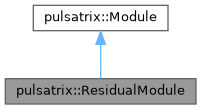
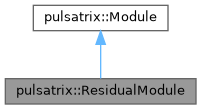
Implements pulsatrix::Module.
◆ compute_device()
| std::optional< DeviceType > pulsatrix::ResidualModule::compute_device |
( |
| ) |
const |
|
inlineoverridevirtual |
◆ forward_impl()
| Tensor pulsatrix::ResidualModule::forward_impl |
( |
const Tensor & |
input | ) |
|
|
overrideprotectedvirtual |
y = x + inner_->forward(x).
- Parameters
-
| input | Any shape inner_ accepts; inner_->forward(input) must return the same shape. |
- Returns
- Same shape as input.
Implements pulsatrix::Module.
◆ inner()
| Module & pulsatrix::ResidualModule::inner |
( |
| ) |
|
|
inline |
◆ named_parameters()
| std::vector< NamedParamRef > pulsatrix::ResidualModule::named_parameters |
( |
| ) |
|
|
overridevirtual |
◆ op_type()
| OpType pulsatrix::ResidualModule::op_type |
( |
| ) |
const |
|
inlineoverridevirtual |
◆ propagate_relevance()
LRP relevance propagation: the residual epsilon/z-rule split between x and inner_->forward(x), then inner_'s own propagate_relevance() for its share.
- Parameters
-
| relevance_out | Relevance at this module's output, matching the cached forward shape. |
| config | Supplies the epsilon stabilizer for the residual split and inner_'s own rule. |
- Returns
- Relevance at this module's input, same shape as relevance_out.
- Exceptions
-
| std::logic_error | if called before any forward(). |
| std::invalid_argument | if relevance_out's shape differs from the cached forward shape. |
- Note
- Device-generic: runs on Cpu, Cuda or Hip tensors (GPU-native-kernels Mission 3).
Implements pulsatrix::Module.
◆ set_training()
| void pulsatrix::ResidualModule::set_training |
( |
bool |
training | ) |
|
|
overridevirtual |
Cascades to inner_, the same way SequentialModule/MultiHeadAttentionModule do.
Reimplemented from pulsatrix::Module.
The documentation for this class was generated from the following file:

 Public Member Functions inherited from pulsatrix::Module
 1.9.8
1.9.8