 |
pulsatrix 1.1.0
|
|
pulsatrix 1.1.0
|
Persistent homology of the Vietoris-Rips filtration in every dimension up to a maximum: components (H0), loops (H1), voids (H2) and beyond, with each feature's critical edges and a representative cocycle. More...
#include <array>#include <cstdint>#include <vector>#include "pulsatrix/tda/distance_matrix.hpp"#include "pulsatrix/tda/persistence_diagram.hpp"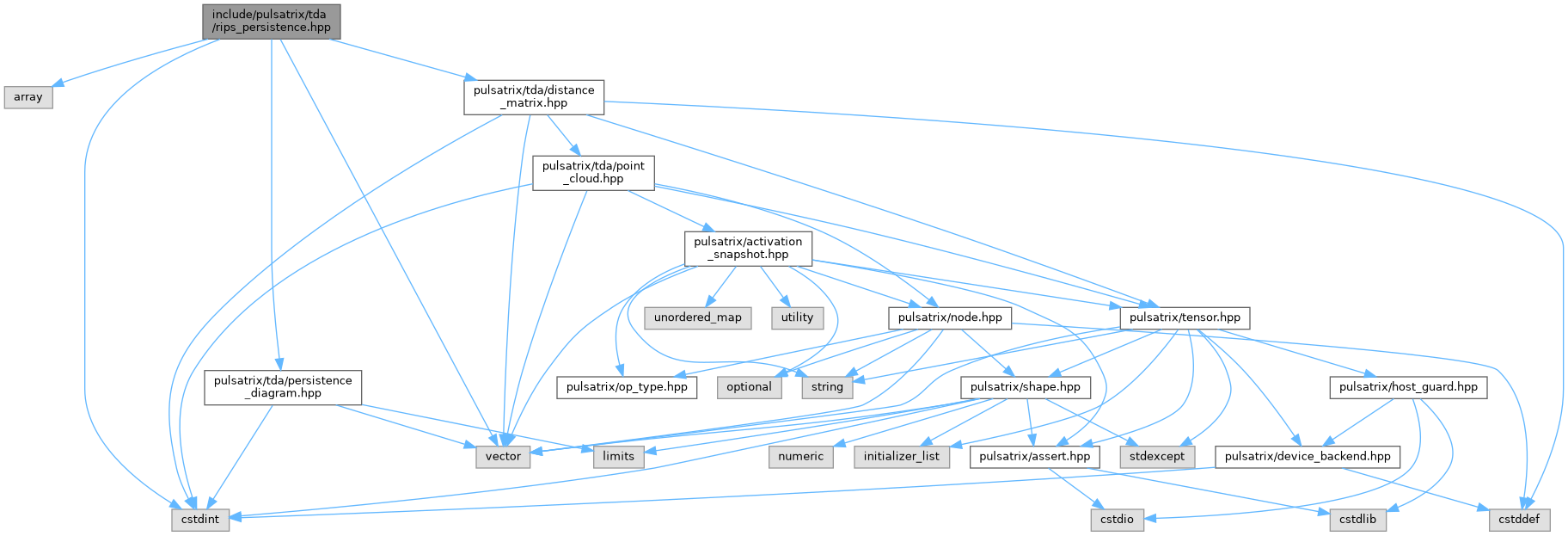
Go to the source code of this file.
Classes | |
| struct | pulsatrix::RipsOptions |
| ComputeRipsPersistence()'s settings. More... | |
| struct | pulsatrix::CocycleEntry |
| One simplex of a cocycle with its coefficient. More... | |
| struct | pulsatrix::RipsFeature |
| One feature of the diagram, with where it comes from. More... | |
| struct | pulsatrix::RipsResult |
| ComputeRipsPersistence()'s result. More... | |
Namespaces | |
| namespace | pulsatrix |
Functions | |
| RipsResult | pulsatrix::ComputeRipsPersistence (const DistanceMatrix &distances, const RipsOptions &options={}) |
| Persistent homology of the Vietoris-Rips filtration on the given distances, in dimensions 0 to options.max_dimension. | |
Persistent homology of the Vietoris-Rips filtration in every dimension up to a maximum: components (H0), loops (H1), voids (H2) and beyond, with each feature's critical edges and a representative cocycle.
The Vietoris-Rips complex at scale t holds every set of points whose pairwise distances are all at most t; a simplex appears at its diameter, the largest distance among its vertices. As t grows, loops and voids form and fill in. Each one is a pair (birth, death) of a persistence diagram.
The computation follows Bauer's Ripser (J. Appl. Comput. Topol. 2021): persistent cohomology, which pairs the same intervals as homology; simplices indexed by the combinatorial number system and their coboundaries enumerated on demand, never stored; columns reduced from the largest scale down, with clearing (a simplex that kills a class one dimension down can't start one); and columns already reduced when first seen, the common case, settled without a reduction. It is written for pulsatrix rather than vendored, over any prime field Z/p.
Cost grows quickly with the dimension. H1 is practical up to a few thousand points and H2 up to about a thousand; beyond that, choose landmarks first. Memory holds every simplex of the highest dimension asked for below the threshold that a lower one doesn't already account for.
 1.9.8