 |
pulsatrix 1.1.0
|
|
pulsatrix 1.1.0
|
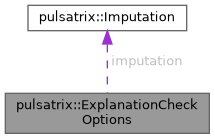
How BuildExplanation() runs the checks. The defaults are the published ones where there is one; each is recorded in Explanation::settings. More...
#include <explanation_report.hpp>
Public Attributes | |
| bool | required_only = false |
| Run only the checks the reason requires, and mark the rest NotRun. | |
| uint64_t | seed = 0 |
| Seed for the random orderings, the input noise and the re-initialized weights. | |
| int64_t | faithfulness_steps = 20 |
| Faithfulness: points on the deletion and insertion curves. | |
| Imputation | imputation = Imputation::Constant(0.0f) |
| Faithfulness: how removed features are filled. Use Imputation::NoisyLinear (ROAD) for images. | |
| int64_t | random_orderings = 19 |
| Faithfulness: random feature orderings to compare with. With 19, passing means beating every one of them, p = 0.05. | |
| double | alpha = 0.05 |
| Faithfulness: the largest p-value that passes. | |
| int64_t | stability_repeats = 2 |
| Stability: extra runs on the same input. | |
| int64_t | perturbations = 3 |
| Stability: runs on the input plus Gaussian noise, skipped for token and symbolic input. | |
| double | perturbation_scale = 0.01 |
| Stability: the noise's standard deviation, as a fraction of the input's. | |
| double | min_stability = 0.8 |
| Stability: the least Spearman correlation of attribution magnitudes that passes, both between repeated runs and under input noise. | |
| double | robustness_radius = 0.05 |
| Robustness: perturbations sampled uniformly within this fraction of the input's spread (L∞), kept when they keep the predicted class. | |
| int64_t | robustness_samples = 10 |
| double | max_sensitivity = 0.5 |
| Robustness: the largest relative change of the explanation that passes, both the largest over the samples (max-sensitivity) and at FGSM's point. | |
| double | conservation_tolerance = 0.05 |
| Conservation: the largest gap between the attributions' sum and the output they explain, as a fraction of that output. | |
| double | max_random_similarity = 0.5 |
| Randomization and null model: the largest Spearman correlation between the trained and the randomized model's attribution magnitudes that passes. | |
How BuildExplanation() runs the checks. The defaults are the published ones where there is one; each is recorded in Explanation::settings.
| double pulsatrix::ExplanationCheckOptions::alpha = 0.05 |
Faithfulness: the largest p-value that passes.
| double pulsatrix::ExplanationCheckOptions::conservation_tolerance = 0.05 |
Conservation: the largest gap between the attributions' sum and the output they explain, as a fraction of that output.
| int64_t pulsatrix::ExplanationCheckOptions::faithfulness_steps = 20 |
Faithfulness: points on the deletion and insertion curves.
| Imputation pulsatrix::ExplanationCheckOptions::imputation = Imputation::Constant(0.0f) |
Faithfulness: how removed features are filled. Use Imputation::NoisyLinear (ROAD) for images.
| double pulsatrix::ExplanationCheckOptions::max_random_similarity = 0.5 |
Randomization and null model: the largest Spearman correlation between the trained and the randomized model's attribution magnitudes that passes.
| double pulsatrix::ExplanationCheckOptions::max_sensitivity = 0.5 |
Robustness: the largest relative change of the explanation that passes, both the largest over the samples (max-sensitivity) and at FGSM's point.
| double pulsatrix::ExplanationCheckOptions::min_stability = 0.8 |
Stability: the least Spearman correlation of attribution magnitudes that passes, both between repeated runs and under input noise.
| double pulsatrix::ExplanationCheckOptions::perturbation_scale = 0.01 |
Stability: the noise's standard deviation, as a fraction of the input's.
| int64_t pulsatrix::ExplanationCheckOptions::perturbations = 3 |
Stability: runs on the input plus Gaussian noise, skipped for token and symbolic input.
| int64_t pulsatrix::ExplanationCheckOptions::random_orderings = 19 |
Faithfulness: random feature orderings to compare with. With 19, passing means beating every one of them, p = 0.05.
| bool pulsatrix::ExplanationCheckOptions::required_only = false |
Run only the checks the reason requires, and mark the rest NotRun.
| double pulsatrix::ExplanationCheckOptions::robustness_radius = 0.05 |
Robustness: perturbations sampled uniformly within this fraction of the input's spread (L∞), kept when they keep the predicted class.
| int64_t pulsatrix::ExplanationCheckOptions::robustness_samples = 10 |
| uint64_t pulsatrix::ExplanationCheckOptions::seed = 0 |
Seed for the random orderings, the input noise and the re-initialized weights.
| int64_t pulsatrix::ExplanationCheckOptions::stability_repeats = 2 |
Stability: extra runs on the same input.
 1.9.8