y = (mean(x^p))^(1/p), reduced over the leading (batch/grounding) axis – not the last axis. Rank-agnostic: input shape (N, ...rest) reduces to output shape (...rest) (rank 0 – a scalar – when input is rank 1, i.e. a single formula's groundings with no other axes).
More...
#include <aggregator_module.hpp>
|
| | AggregatorModule (DeviceBackend *backend, float p=2.0f) |
| | Constructs a p-mean aggregator.
|
| |
| Tensor | backward (const Tensor &grad_output) override |
| | Gradient w.r.t. this module's input, via agg_p's closed-form partial derivative.
|
| |
| OpType | op_type () const override |
| | Reduction, per charter's closed OpType set – this is the campaign's first reduction-shaped (rather than elementwise) operator.
|
| |
| Tensor | propagate_relevance (const Tensor &relevance_out, const LRPRuleConfig &config) override |
| | LRP relevance propagation – genuinely novel, no prior art (research_2026_neuro_symbolic_ai.md §3's honest finding, same standing as every Mission 0 rule); hand-derived here, conservation-tested before this implementation existed.
|
| |
| float | p () const |
| | This aggregator's configured exponent.
|
| |
| std::optional< DeviceType > | compute_device () const override |
| | Where this layer computes, so forward() rejects an input on another device (FND-8).
|
| |
| virtual | ~Module ()=default |
| |
| Tensor | forward (const Tensor &input) |
| | Runs this module's forward computation.
|
| |
| std::pair< Tensor, NodeId > | forward_traced (const Tensor &input, NodeId input_node, ComputationGraph &graph, Autograd &autograd) |
| | Runs forward() while also registering a ComputationGraph node (tagged with this module's op_type(), parented to input_node) and wiring an Autograd backward function that reuses this module's own backward() – the opt-in traced/explainable path, per Phase 2 Mission 0.
|
| |
| virtual bool | supports_lrp_rule (LRPRule rule) const |
| | Whether propagate_relevance() implements rule (no silent fallback: callers such as ExplainerContext::relevance_pass() throw rather than run a module on a rule it does not implement).
|
| |
| virtual std::vector< NamedParamRef > | named_parameters () |
| | This module's trainable parameters, each with its hierarchical name – the one place a module declares its parameters (roadmap FND-1).
|
| |
| virtual std::vector< ParamRef > | parameters () |
| | This module's trainable parameters and their gradients, for an optimizer to update uniformly across module types.
|
| |
| void | set_requires_grad (bool requires_grad, const std::string &prefix="") |
| | Freezes (false) or unfreezes (true) parameters by name (roadmap FND-2).
|
| |
| virtual void | set_training (bool training) |
| | Sets this module's training/eval mode. Defaults to training (matches every mainstream framework's Module default).
|
| |
| bool | is_training () const |
| | Whether this module is currently in training mode.
|
| |
|
| Tensor | forward_impl (const Tensor &input) override |
| | Computes agg_p over the leading (batch) axis, per remaining "column" (every fixed combination of the trailing dimensions).
|
| |
y = (mean(x^p))^(1/p), reduced over the leading (batch/grounding) axis – not the last axis. Rank-agnostic: input shape (N, ...rest) reduces to output shape (...rest) (rank 0 – a scalar – when input is rank 1, i.e. a single formula's groundings with no other axes).
- Note
- Design decision (mission_1_aggregator_satisfaction_loss.md Stage 3, resolved): no Stack-based wrapper needed. Unlike ConjunctionModule/DisjunctionModule (genuinely binary, two independent external operand tensors, needing stack_operands()), AggregatorModule is unary – one batch of groundings in, one reduced tensor out – and fits Module::forward()'s existing single-Tensor contract directly, with no design question to resolve (mirrors NegationModule's identical "no wrapper needed" note, mission_0's own Stage 3). Verified explicitly, not assumed silently, per this mission file's own carried-forward Stage 3 prompt.
-
Reduction axis is the leading dimension (axis 0), not the last axis – deliberately the opposite convention from SoftmaxModule (which reduces the last axis, per-row, because that axis is the class/feature axis in softmax's own problem). Here the axis being aggregated over is the batch axis (§2's "batch of
groundings" framing) – this codebase's own standing convention is that the batch dimension is the leading one (Tensor::Stack concatenates along the leading dimension; GroupNormModule computes per-batch-row statistics indexed by the leading
n). Reducing axis 0 is therefore the semantically correct choice for "aggregate a formula's per-grounding truth degrees into one satisfaction degree", not an arbitrary pick between two equally-valid axes.
-
**
p == 0 is rejected at construction** (std::invalid_argument) – the pure power-mean formula is undefined there (mean(x^0) == 1 identically, then 1^(1/0) is undefined; the true p -> 0 limit is the geometric mean, a genuinely different formula this class does not implement). Checked once at construction, not per-call, since it is a fixed configuration value, not a per-element runtime input – cheaper and earlier than a hot-path check.
-
Negative
x with non-integer p, or x == 0 with negative p, are deliberately NOT validated or rejected – same policy as ConjunctionModule/DisjunctionModule's out-of-range-input note (mission_0_tnorm_operators.md Stage 3): std::pow already gives the honest floating-point answer for these domains (NaN for a negative base raised to a non-integer exponent, +-inf for 0 raised to a negative exponent), and adding a per-element domain check to every forward/backward/propagate_relevance call would cost hot-path time this codebase's convention avoids elsewhere. Verified by test (*HandlesNegativeInputWithNonIntegerPWithoutThrowing-style adversarial cases in aggregator_module_test.cpp), not enforced by code.
◆ AggregatorModule()
| pulsatrix::AggregatorModule::AggregatorModule |
( |
DeviceBackend * |
backend, |
|
|
float |
p = 2.0f |
|
) |
| |
|
explicit |
Constructs a p-mean aggregator.
- Parameters
-
| backend | Backend to allocate/compute through. Not owned; must outlive this module. |
| p | Aggregator exponent. p == 1 is the arithmetic mean; p == 2 is the RMS (root-mean-square, a common LTN "soft-forall" choice, since larger p weighs low-truth groundings more heavily, approaching a true min/forall as p -> +inf). Defaults to 2.0. |
- Exceptions
-
| std::invalid_argument | if p == 0 – see the class note above. |
◆ backward()
| Tensor pulsatrix::AggregatorModule::backward |
( |
const Tensor & |
grad_output | ) |
|
|
overridevirtual |
Gradient w.r.t. this module's input, via agg_p's closed-form partial derivative.
Derivation: let m = mean(x^p) = (1/n) * sum_i(x_i^p), y = m^(1/p). Then dy/dx_i = (1/p) * m^(1/p - 1) * dm/dx_i = (1/p) * m^(1/p - 1) * (p/n) * x_i^(p-1) = (1/n) * m^(1/p - 1) * x_i^(p-1). Implemented directly in this closed form (not rearranged into a y-based division) so it stays well-defined at y == 0 for every p where the direct m-based powers themselves are well-defined (e.g. p == 1, where this reduces to the constant 1/n independent of m/y entirely – the ordinary mean's own gradient).
- Parameters
-
| grad_output | Gradient w.r.t. this module's output. Must match the shape of the most recent forward() call's output (input shape with the leading dim dropped). |
- Returns
- Gradient w.r.t. this module's input, same shape as that forward() call's input.
- Exceptions
-
| std::logic_error | if called before any forward(). |
| std::invalid_argument | if grad_output's shape differs from the cached output shape. |
- Note
- Device-generic: runs on Cpu, Cuda or Hip tensors (GPU-native-kernels Mission 3).
Implements pulsatrix::Module.
◆ compute_device()
| std::optional< DeviceType > pulsatrix::AggregatorModule::compute_device |
( |
| ) |
const |
|
inlineoverridevirtual |
◆ forward_impl()
| Tensor pulsatrix::AggregatorModule::forward_impl |
( |
const Tensor & |
input | ) |
|
|
overrideprotectedvirtual |
Computes agg_p over the leading (batch) axis, per remaining "column" (every fixed combination of the trailing dimensions).
- Parameters
-
| input | Input tensor. Must be rank >= 1 (the leading batch axis) – external boundary: forward_impl is reachable directly through the inherited, non-virtual Module::forward(const Tensor&) by any caller, and a rank-0 tensor (a bare scalar, no batch axis at all) has no leading dimension to reduce. |
- Returns
agg_p(input), shape equal to input's shape with the leading dim dropped.
- Exceptions
-
| std::invalid_argument | if input's rank is 0. |
Implements pulsatrix::Module.
◆ op_type()
| OpType pulsatrix::AggregatorModule::op_type |
( |
| ) |
const |
|
inlineoverridevirtual |
Reduction, per charter's closed OpType set – this is the campaign's first reduction-shaped (rather than elementwise) operator.
Implements pulsatrix::Module.
◆ p()
| float pulsatrix::AggregatorModule::p |
( |
| ) |
const |
|
inline |
This aggregator's configured exponent.
◆ propagate_relevance()
LRP relevance propagation – genuinely novel, no prior art (research_2026_neuro_symbolic_ai.md §3's honest finding, same standing as every Mission 0 rule); hand-derived here, conservation-tested before this implementation existed.
Derivation, via Euler's homogeneous-function theorem (the same gradient-times-input identity this codebase's other epsilon-rule derivations already rest on, e.g. LinearModule's weighted sum): for any fixed t > 0, agg_p(t*x) = t * agg_p(x) (scaling every grounding by t scales the aggregated result by the same t) – i.e. agg_p is positively homogeneous of degree 1 in x. Euler's theorem for a degree-1-homogeneous, differentiable function states sum_i(x_i * dy/dx_i) == y exactly. Substituting this module's own dy/dx_i (backward()'s closed form) gives the local (gradient x input) relevance term: z_i = x_i * dy/dx_i = x_i * (1/n) * m^(1/p-1) * x_i^(p-1) = (1/n) * x_i^p * m^(1/p-1). Using m^(1/p-1) = m^(1/p)/m = y/m (valid for m != 0) collapses this to z_i = (1/n) * x_i^p * y/m = (x_i^p / (n*m)) * y, and since n*m == sum_j(x_j^p) exactly (m's own definition), sum_i(z_i) = (sum_i(x_i^p) / sum_j(x_j^p)) * y == y – Euler's theorem confirmed directly from the closed form, not just cited abstractly. The final rule redistributes R_out by each grounding's share of sum_j(x_j^p) (an epsilon-stabilized denominator, this codebase's standard stabilization convention): R_i = (x_i^p / (sum_j(x_j^p) + eps*sign(sum_j(x_j^p)))) * R_out. This is a genuinely new derivation (no literature applies an Euler-homogeneity gradient-times-input decomposition to a p-mean aggregator; research doc §3's literature search found no LRP-style rule for any quantifier aggregator at all) – the campaign's second, after Mission 0's t-norm/t-conorm rules, novel contribution.
- Parameters
-
| relevance_out | Relevance at this module's output. Must match forward()'s shape. |
| config | Selects the epsilon stabilizer (same role as every other epsilon-stabilized rule in this codebase). |
- Returns
- Relevance at this module's input, same shape as the cached forward() input.
- Exceptions
-
| std::logic_error | if called before any forward(). |
| std::invalid_argument | if relevance_out's shape differs from the cached output shape. |
- Note
- Conserves near-exactly (
sum_i(R_i) ~= R_out), same class as every other epsilon-stabilized rule in this codebase (LinearModule, ResidualModule, DisjunctionModule's Product rule) – not exact, since the epsilon stabilizer introduces a bounded, provably small gap. Exact when config.epsilon == 0 and sum_j(x_j^p) != 0 (verified by a dedicated test using p == 1, where the derivation collapses to the same exact-conservation shape as an ordinary mean).
Implements pulsatrix::Module.
The documentation for this class was generated from the following file:

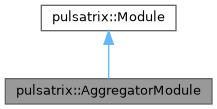
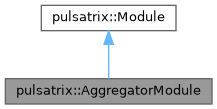
 Public Member Functions inherited from pulsatrix::Module
 1.9.8
1.9.8