An n-dimensional grid: state is an integer coordinate in [0, H-1]^ndim, actions increment one coordinate or stop the episode, reward is concentrated near the grid's corners.
More...
#include <hypergrid_env.hpp>
|
| | HyperGridEnv (DeviceBackend *backend, int64_t ndim=2, int64_t side_length=8, float r0=0.1f, float r1=0.5f, float r2=2.0f, int64_t max_steps=64) |
| | Constructs a fresh, not-yet-reset HyperGrid environment.
|
| |
| Tensor | reset () override |
| | Starts a new episode at the origin (0, ..., 0).
|
| |
| Tensor | reset (const Tensor &initial_state) override |
| | Starts a new episode from an exact caller-supplied state.
|
| |
| StepResult | step (const Tensor &action) override |
| | Advances the episode one step: increments a coordinate, or stops.
|
| |
| float | reward (const Tensor &state) const |
| | The reward of an arbitrary valid grid state, independent of this environment's current episode state.
|
| |
| float | backward_log_prob (const Tensor &state, int64_t action) const |
| | The closed-form uniform backward-policy log-probability P_B(a|state).
|
| |
| std::vector< bool > | valid_actions_mask (const Tensor &state) const |
| | Which actions are legal to take from an arbitrary valid state.
|
| |
| int64_t | observation_dim () const override |
| | Number of grid dimensions, as passed to the constructor.
|
| |
| int64_t | action_dim () const override |
| | ndim() + 1 – one increment action per dimension, plus stop.
|
| |
| bool | is_discrete () const override |
| | True – HyperGrid's action space is discrete.
|
| |
| int64_t | ndim () const |
| | Number of grid dimensions. Alias for observation_dim(), named for readability at HyperGrid-specific call sites.
|
| |
| int64_t | side_length () const |
| | Number of cells per dimension (H), as passed to the constructor.
|
| |
| int64_t | max_steps () const |
| | Episode length safety cap this environment was constructed with.
|
| |
| int64_t | step_count () const |
| | Steps taken since the last reset().
|
| |
| virtual | ~Environment ()=default |
| |
An n-dimensional grid: state is an integer coordinate in [0, H-1]^ndim, actions increment one coordinate or stop the episode, reward is concentrated near the grid's corners.
- Note
- Deliberately not a reproduction of any single paper's exact reward constants – see mission_hypergrid_env.md's Design section for the reward shape this class implements and why it was chosen (a real, non-degenerate near-corner band distinct from the exact-corner set, hand-verifiable at named cells for the default side_length).
-
Deterministic reset() to the origin – unlike CartPoleEnv's randomized reset, this environment's whole purpose is a fixed, hand-traceable start state.
-
Reward is 0 at every non-terminal step and R(x) only at the terminal state (the
stop action or the max_steps cap) – the standard GFlowNet convention that R is a property of the terminal object x, not of any intermediate transition.
◆ HyperGridEnv()
| pulsatrix::HyperGridEnv::HyperGridEnv |
( |
DeviceBackend * |
backend, |
|
|
int64_t |
ndim = 2, |
|
|
int64_t |
side_length = 8, |
|
|
float |
r0 = 0.1f, |
|
|
float |
r1 = 0.5f, |
|
|
float |
r2 = 2.0f, |
|
|
int64_t |
max_steps = 64 |
|
) |
| |
|
explicit |
Constructs a fresh, not-yet-reset HyperGrid environment.
- Parameters
-
| backend | Backend to allocate observation tensors through. Not owned; must outlive this object. |
| ndim | Number of grid dimensions. Must be >= 1. |
| side_length | Number of cells per dimension (H). Must be >= 4 – below that the near-corner band (Design section) degenerates to exactly the corner set, which would make R1 and R2 indistinguishable rather than a real distinct band. |
| r0 | Base reward, everywhere. Must be >= 0. |
| r1 | Additional reward in the near-corner band. Must be >= 0. |
| r2 | Additional reward exactly at a corner. Must be >= 0. |
| max_steps | Episode length safety cap – forces termination (as if stop were taken) if reached without one. Must be >= 1. |
- Exceptions
-
| std::invalid_argument | on any violated precondition above – external boundary, same classification as CartPoleEnv's constructor. |
◆ action_dim()
| int64_t pulsatrix::HyperGridEnv::action_dim |
( |
| ) |
const |
|
inlineoverridevirtual |
◆ backward_log_prob()
| float pulsatrix::HyperGridEnv::backward_log_prob |
( |
const Tensor & |
state, |
|
|
int64_t |
action |
|
) |
| const |
The closed-form uniform backward-policy log-probability P_B(a|state).
- Parameters
-
| state | Grid coordinate, shape (1, ndim()), each entry an integer-valued float in [0, side_length()-1]. |
| action | Dimension index [0, ndim()) – decrementing this coordinate must reach a valid parent state. |
- Returns
log(1 / count_nonzero(state)) – HyperGrid's action structure (exactly one way to reach any non-origin state, by incrementing one coordinate) makes the correct backward distribution uniform over state's nonzero coordinates; see mission_shared_gflownet_machinery.md's Recon for why this is closed-form rather than a second learned policy.
- Exceptions
-
| std::invalid_argument | if state is invalid (same validation as reward()), if action is out of [0, ndim()), or if state[action] == 0 (decrementing it would leave the grid – not a valid parent transition) – all external boundary. |
- Note
- A pure function, like reward() – no precondition on reset() having been called.
◆ is_discrete()
| bool pulsatrix::HyperGridEnv::is_discrete |
( |
| ) |
const |
|
inlineoverridevirtual |
◆ max_steps()
| int64_t pulsatrix::HyperGridEnv::max_steps |
( |
| ) |
const |
|
inline |
Episode length safety cap this environment was constructed with.
◆ ndim()
| int64_t pulsatrix::HyperGridEnv::ndim |
( |
| ) |
const |
|
inline |
Number of grid dimensions. Alias for observation_dim(), named for readability at HyperGrid-specific call sites.
◆ observation_dim()
| int64_t pulsatrix::HyperGridEnv::observation_dim |
( |
| ) |
const |
|
inlineoverridevirtual |
◆ reset() [1/2]
| Tensor pulsatrix::HyperGridEnv::reset |
( |
| ) |
|
|
overridevirtual |
Starts a new episode at the origin (0, ..., 0).
- Returns
- The initial observation, shape (1, ndim()).
- Note
- No randomness – HyperGrid's whole point is a fixed, hand-traceable start state.
Implements pulsatrix::Environment.
◆ reset() [2/2]
| Tensor pulsatrix::HyperGridEnv::reset |
( |
const Tensor & |
initial_state | ) |
|
|
overridevirtual |
Starts a new episode from an exact caller-supplied state.
- Parameters
-
| initial_state | Grid coordinate, shape (1, ndim()), each entry an integer-valued float in [0, side_length()-1]. |
- Returns
- The initial observation (a copy of initial_state's values), shape (1, ndim()).
- Exceptions
-
| std::invalid_argument | if initial_state's shape is wrong, an entry is not within a small tolerance of an integer, or an entry is out of [0, side_length()-1] – all external boundary. |
Implements pulsatrix::Environment.
◆ reward()
| float pulsatrix::HyperGridEnv::reward |
( |
const Tensor & |
state | ) |
const |
The reward of an arbitrary valid grid state, independent of this environment's current episode state.
- Parameters
-
| state | Grid coordinate, shape (1, ndim()), each entry an integer-valued float in [0, side_length()-1]. |
- Returns
R(state) per the Design section's formula.
- Exceptions
-
| std::invalid_argument | if state's shape or entries are invalid – external boundary, same validation as reset(const Tensor&). |
- Note
- A pure function – no precondition on reset() having been called, no mutation. Later missions (TrajectoryBalanceLoss and friends) need R(x) at a sampled terminal state directly, without re-driving the environment through step().
◆ side_length()
| int64_t pulsatrix::HyperGridEnv::side_length |
( |
| ) |
const |
|
inline |
Number of cells per dimension (H), as passed to the constructor.
◆ step()
Advances the episode one step: increments a coordinate, or stops.
- Parameters
-
| action | Shape (1, 1), holding the action index as a float: [0, ndim()) increment that coordinate, ndim() stops the episode at the current state. |
- Returns
- The resulting observation, reward (0 unless this step is terminal), and whether the episode ended (via
stop, an implicit max_steps cap, or neither).
- Exceptions
-
| std::invalid_argument | if reset() has never been called, the action's shape is wrong, the decoded index is out of range, or an increment action would move a coordinate past side_length()-1 (illegal off-grid move) – all external boundary: any of these can originate from an untrained or malformed policy. |
| std::logic_error | if the most recent step already reported done=true – a GFlowNet trajectory has no meaning past its terminal state; unlike CartPoleEnv, this is enforced here rather than left to the caller. |
- Note
- Host boundary (GPU-native-kernels Mission 7): the grid walk is integer host logic.
action (and every state argument of reset()/reward()/backward_log_prob()/ valid_actions_mask()) may live on any device – one device->host copy per call – and observations are returned through this environment's own backend.
Implements pulsatrix::Environment.
◆ step_count()
| int64_t pulsatrix::HyperGridEnv::step_count |
( |
| ) |
const |
|
inline |
Steps taken since the last reset().
◆ valid_actions_mask()
| std::vector< bool > pulsatrix::HyperGridEnv::valid_actions_mask |
( |
const Tensor & |
state | ) |
const |
Which actions are legal to take from an arbitrary valid state.
- Parameters
-
| state | Grid coordinate, shape (1, ndim()), each entry an integer-valued float in [0, side_length()-1]. |
- Returns
- A mask of size action_dim(): entry
i < ndim() is true iff state[i] < side_length()-1 (incrementing that coordinate stays on the grid); entry ndim() (stop) is always true.
- Exceptions
-
| std::invalid_argument | if state is invalid – same validation as reward(). |
- Note
- A pure function, like reward()/backward_log_prob() – no precondition on reset() having been called.
GFlowNetForwardPolicy::sample() needs this mask to avoid ever sampling an illegal increment that would make step() throw.
The documentation for this class was generated from the following file:

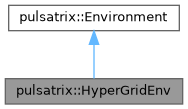
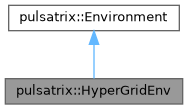
 Public Member Functions inherited from pulsatrix::Environment
 1.9.8
1.9.8