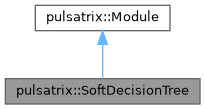
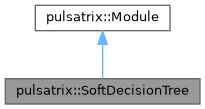
Frosst and Hinton's soft decision tree, (N, inputs) to (N, classes) log-probabilities.
More...
|
| | SoftDecisionTree (int64_t inputs, int64_t classes, DeviceBackend *backend, SoftDecisionTreeOptions options={}) |
| |
| Tensor | backward (const Tensor &grad_output) override |
| | Computes the gradient w.r.t. this module's input, given the gradient w.r.t. its output. Must be called after forward() – uses state cached from that call.
|
| |
| Tensor | propagate_relevance (const Tensor &relevance_out, const LRPRuleConfig &config) override |
| | Computes this module's contribution to LRP relevance propagation.
|
| |
| bool | supports_lrp_rule (LRPRule) const override |
| | Whether propagate_relevance() implements rule (no silent fallback: callers such as ExplainerContext::relevance_pass() throw rather than run a module on a rule it does not implement).
|
| |
| OpType | op_type () const override |
| | This module's operation-category tag, for ComputationGraph node tagging.
|
| |
| std::vector< NamedParamRef > | named_parameters () override |
| | gates.weight, gates.bias and leaves.
|
| |
| std::vector< NamedModuleRef > | named_children () override |
| | This module's direct sub-modules, each under the prefix its parameters carry in named_parameters(), in the same order (TRN-7: how ApplyLora() finds a model's Linear layers). Default: none. NamedModules() walks the whole tree.
|
| |
| int | depth () const |
| |
| int64_t | num_inner () const |
| |
| int64_t | num_leaves () const |
| |
| int64_t | num_inputs () const |
| |
| int64_t | num_classes () const |
| |
| const SoftDecisionTreeOptions & | options () const |
| |
| LinearModule & | gates () |
| | The gates: column i of its (inputs, inner) weight and entry i of its bias are node i's w_i and b_i.
|
| |
| Tensor & | leaf_logits () |
| | The leaves' logits φ, (leaves, classes).
|
| |
| std::vector< double > | LeafDistributions () const |
| | The leaves' distributions softmax(φ), row-major (leaves, classes).
|
| |
| const std::vector< double > & | right_probabilities () const |
| | From the last forward(): each input's probability of going right at each inner node, (N, inner), and of reaching each leaf, (N, leaves), row-major.
|
| |
| const std::vector< double > & | leaf_probabilities () const |
| |
| double | penalty () const |
| | The last forward()'s balance penalty C, λ included; 0 when λ is 0. Add it to the loss you report: backward() adds its gradient.
|
| |
| std::vector< int64_t > | MostProbableLeaf () const |
| | For each input of the last forward(), the leaf its most probable path ends at: the greedy path, taking the likelier branch at every node, as Frosst and Hinton do.
|
| |
| std::vector< std::pair< int64_t, bool > > | PathTo (int64_t leaf) const |
| | The inner nodes on the path from the root to leaf, root first, and whether the path goes right at each.
|
| |
| virtual | ~Module ()=default |
| |
| Tensor | forward (const Tensor &input) |
| | Runs this module's forward computation.
|
| |
| virtual std::optional< DeviceType > | compute_device () const |
| | The device this module computes on, so forward() can reject an input on another device before any kernel sees it (roadmap FND-8).
|
| |
| std::pair< Tensor, NodeId > | forward_traced (const Tensor &input, NodeId input_node, ComputationGraph &graph, Autograd &autograd) |
| | Runs forward() while also registering a ComputationGraph node (tagged with this module's op_type(), parented to input_node) and wiring an Autograd backward function that reuses this module's own backward() – the opt-in traced/explainable path, per Phase 2 Mission 0.
|
| |
| virtual std::vector< NamedBufferRef > | named_buffers () |
| | This module's buffers: state a checkpoint must save that no optimizer updates.
|
| |
| virtual std::vector< ParamRef > | parameters () |
| | This module's trainable parameters and their gradients, for an optimizer to update uniformly across module types.
|
| |
| void | set_requires_grad (bool requires_grad, const std::string &prefix="") |
| | Freezes (false) or unfreezes (true) parameters by name (roadmap FND-2).
|
| |
| virtual void | set_training (bool training) |
| | Sets this module's training/eval mode. Defaults to training (matches every mainstream framework's Module default).
|
| |
| bool | is_training () const |
| | Whether this module is currently in training mode.
|
| |
| virtual void | release_activations () |
| | Frees the tensors forward() kept for backward() and the relevance passes; containers release their children too. Inference that only needs the output calls it after each forward, so a deep model holds one layer's activations at a time (a 1024-token ESM-2 650M pass otherwise keeps over 10 GB of them).
|
| |
Frosst and Hinton's soft decision tree, (N, inputs) to (N, classes) log-probabilities.
- Note
- The routing and the leaves are computed on the host in double precision; the gates' linear layer runs on the backend's device, and the output comes back on the input's device.
-
LRP isn't defined for it: propagate_relevance() throws. Explain it with its paths, or with gradient explainers.

 Public Member Functions inherited from pulsatrix::Module
 1.9.8